
Windsor Racecourse Draw Bias: Stall Data, Pace Patterns and Going Analysis
Best Horse Racing Betting Sites – Bet on Horse Racing in 2026
Loading...
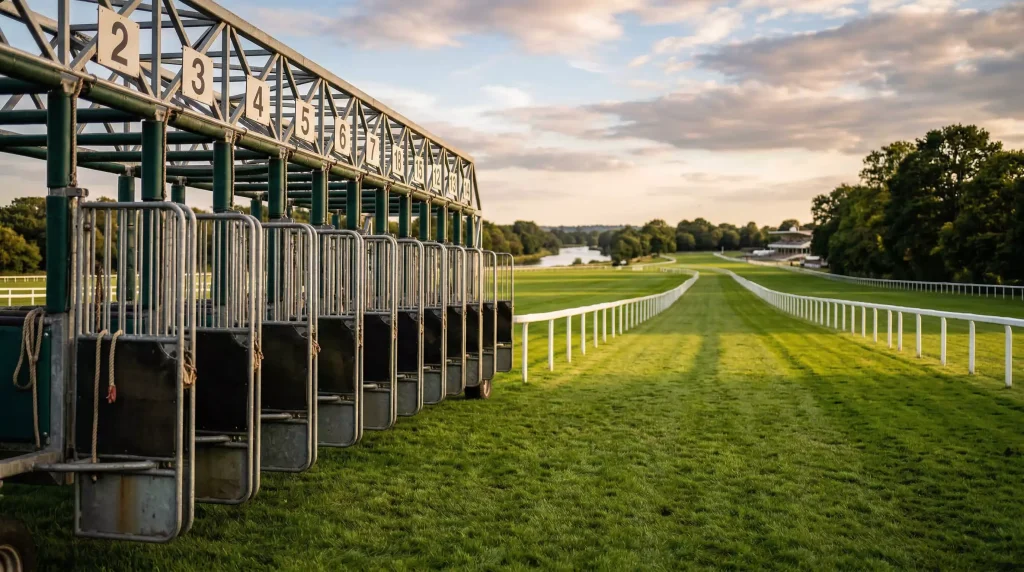
At most British racecourses, the draw conversation starts and ends with a stall number. Low is good at Chester, high is good at Beverley, and the rest falls somewhere in between. Windsor racecourse draw bias does not follow that script. The figure-of-eight layout — one of only two in the country — sends horses across intersecting paths, which means that the geometry of a six-furlong dash bears almost no relation to the geometry of a ten-furlong test. A decade of results data confirms what experienced punters have suspected for years: position is a starting advantage, pace is the race itself.
That distinction matters because Windsor’s home straight runs a full five furlongs, longer than almost any comparable track in southern England. A horse that gets to the front early has tarmac-length runway to defend its lead, and the numbers reflect it: front-runners at Windsor win at roughly four times the rate of hold-up performers. The draw, then, is not irrelevant — but it operates in the shadow of pace. Understanding when the stall number matters and when running style overrides it is the difference between a sharp wager and a stab in the dark.
What follows is a distance-by-distance breakdown of stall performance across sprints and middle distances, the pace bias that dominates every trip, the effect of going on draw advantage, and a practical checklist for applying all of it before the next Monday evening card. The data draws primarily on FlatStats figures from 2015 to 2026 and analysis from HorseRacingBettingSites, filtered for fields of ten or more runners where draw effects are statistically meaningful.
Sprint Distances: 5f and 6f Draw Data
Windsor’s six-furlong trip is, by the standards of British racing, unusually straightforward. The course runs almost entirely in a straight line from the start near the far bend to the finish in front of the grandstand, with only the slightest deviation around the course’s famous elbow. Horses drawn wide do not lose ground on a tight turn — because there is no tight turn to negotiate. On good to firm going, that makes the draw at six furlongs one of the weakest biases at any major UK track. Low, middle, high — ten years of FlatStats data show minimal separation between stall groups in fields of ten-plus runners when the ground is quick.
The picture shifts on softer surfaces. When the going turns soft or heavy, higher-numbered stalls — those positioned closer to the far-side rail — gain a measurable edge over the sprint trip. The explanation is drainage. Windsor sits on an island in the Thames, and while the proximity to the river helps water drain quickly overall, soft conditions tend to leave the stand-side strip more cut up than the far side, particularly later in a card. A horse drawn high can hug the fresher ground for the entire six furlongs without needing to cross the track at any point. That positional advantage compounds when several races have already chewed up the stand-side turf.
At five furlongs the dynamics are similar but compressed. The course is even straighter, with start and finish separated by little more than a furlong of gradually curving turf. On quick going, stall position barely registers in the results. On soft going, higher stalls again offer a slight edge, though the sample size at five furlongs is smaller because Windsor schedules fewer minimum-trip races than some other southern tracks.
One common mistake is to overweight individual draw statistics from small fields. Windsor sprint handicaps regularly attract eight or nine runners, and in fields of that size the draw contribution is dwarfed by class and fitness. The stall data only becomes reliable in double-figure fields — and even then, it is the going that tells you whether the draw matters at all. Good ground, ignore it. Soft ground, respect the high numbers.
What the sprint data does not capture is pace, and that is the variable that deserves the bigger asterisk. A front-runner drawn low in stall two on soft ground might still win comfortably if nothing else in the field wants to lead. The draw sets the stage; pace writes the script. That theme intensifies over middle distances.
For punters who rely on FlatStats draw ranges divided into thirds — low, middle, high — the sprint summary at Windsor is reassuringly simple. On standard going, the thirds are essentially level. On soft or worse, the top third edges ahead. No other sprint-course quirk rivals the impact of pace, which we will return to after examining the middle distances.
Middle Distances: 1m to 1m3f99y
Races from a mile upward at Windsor use a completely different portion of the track, and the figure-of-eight layout begins to exert its full influence. Where the sprint course is nearly straight, the middle-distance route incorporates a series of right-hand bends — and only right-hand bends. That single-direction geometry gives an immediate advantage to horses drawn low, who sit closest to the inside rail through every turn. Unlike a galloping oval, there is no left-hand arc to rebalance the field. Low stalls maintain the positional edge from start to home straight without ever being forced wide.
The home straight itself runs five furlongs, with a gentle elbow approximately three furlongs from the finish. That elbow is subtle on camera but significant in the saddle. A horse travelling on the outside as the field rounds it loses roughly half a length compared with one hugging the rail. In a tight Group-race finish, half a length is the difference between first and third. The elbow is a reliable ally for low-drawn runners who have raced prominently: they approach it on the shortest line and emerge from it with the clearest run to the post.
The Winter Hill Stakes provides the starkest evidence. Over the last thirteen renewals of the race — Windsor’s only Group 3 event, run over a mile and two furlongs — stall one has produced five winners. Stall two has produced another two. Between them, the two lowest draws account for more than half of all Winter Hill victories in over a decade. No other single-course, single-race draw statistic in British racing is quite so lopsided.
Does that mean punters should blindly back stall one in every middle-distance race at Windsor? No, and for two reasons. First, the Winter Hill is typically a small-field affair — seven or eight runners — where the inside berth is proportionally more valuable because there is less traffic to negotiate. In a twenty-runner mile handicap on a Monday night, the advantage of stall one dilutes considerably. Second, jockeys in bigger fields sometimes choose to cross from a high draw to the rail early, absorbing the initial ground loss in exchange for a better position through the bends. That tactical decision depends almost entirely on pace: if nobody else wants to lead, even a wide-drawn horse can slot across without wasting energy.
The one-mile-three-furlong-and-ninety-nine-yard trip — Windsor’s peculiar maximum flat distance — follows the same principles, only more so. The longer the race, the more bends the field negotiates, and the more the low-draw advantage accumulates. Staying races at Windsor are not common in the calendar, but when they appear, stall position deserves serious weight in the form assessment.
Pace Bias: The Dominant Factor
If draw bias is the headline at Windsor, pace bias is the editorial. Across all distances and all going descriptions, horses that race prominently — at or near the front of the field — win at approximately four times the rate of those held up in the rear. That ratio, documented by HorseRacingBettingSites, makes Windsor one of the most pace-biased flat tracks in Britain. The explanation begins and ends with the home straight.
Five furlongs of uninterrupted turf between the final bend and the winning post is an enormous stretch by British standards. At courses like Sandown or Kempton, the home straight might be two or three furlongs, giving closers a realistic window to overhaul a tiring leader in the final hundred yards. At Windsor, a front-runner who is still travelling at the two-furlong pole has three furlongs of daylight ahead of it and no camber, no undulation, and no blind turn to disrupt its rhythm. Hold-up horses must produce a sustained acceleration over a longer distance — and most simply cannot sustain that effort against a rival who already has momentum and position.
“Reverting to the figure-of-eight will improve the balance of the horse’s stride, which in turn improves galloping and jumping and reduces injury risk,” said Clive Hamblin, Senior Veterinary Surgeon at Windsor and veterinary advisor to the National Trainers’ Federation, discussing the 2026 track reconfiguration. Although Hamblin’s comment was directed at jump racing, the biomechanical principle applies to flat races too: a balanced stride on the figure-of-eight layout rewards horses that establish an even tempo early rather than those who accelerate violently from the rear.
The interaction between draw and pace is where the analysis gets genuinely useful. Consider a six-furlong sprint on soft ground. The draw data tells you to favour high stalls. The pace data tells you to favour front-runners. If a prominent racer is drawn high, both biases align — that horse has a statistical tailwind. If the natural front-runner is drawn low and the ground is soft, the two signals conflict, and the outcome becomes less predictable. Smart punters map both factors onto the field before making a judgment.
At middle distances, pace bias remains dominant but expresses itself differently. The bends slow the field slightly, which means that a leader setting honest fractions will not open up a gap as easily as in a sprint. But the long home straight still offers the same protection. Once the leader straightens for home, the closers face the same five-furlong pursuit — and by now they have also had to negotiate the bends without the benefit of the inside rail if they were drawn wide. The combination of pace advantage and low-draw advantage is why front-running horses drawn in stalls one through three are so dangerous at a mile and beyond.
There is a counterargument that pace bias is simply the artefact of better horses being ridden more prominently by better jockeys, rather than a genuine track effect. That argument has some validity across British racing in general, but the scale of the bias at Windsor — four to one, not the industry-average two to one — suggests something specific to the course geometry. The length of the straight is the most likely cause. Position is the starting advantage; pace is the race itself, and at Windsor, pace usually wins the argument.
Going Ground: How the Surface Changes the Bias
Going transforms draw bias from a marginal footnote into a decisive factor, and at Windsor the transformation is sharper than at most courses. On good to firm ground — the standard for the summer Monday-night cards — stall position is close to irrelevant over sprint distances and only mildly influential over a mile. The turf is fast, the drainage is sound, and the surface wears evenly across the width of the track. Punters who ignore the draw entirely on a quick evening card are unlikely to miss much.
On soft or heavy ground, the bias activates. Higher-numbered stalls gain an advantage at sprint trips because the far-side strip of turf tends to retain firmer footing. Windsor’s island location means the water table is close to the surface everywhere, but the stand side — where the most traffic flows and the going stick readings are typically taken — absorbs more punishment. A horse drawn in stall twelve on soft ground at six furlongs can race on relatively untouched turf for the entire distance, while a horse drawn in stall two may struggle through deeper, cut-up ground.
“Proximity to the Thames gives us excellent drainage,” Mark Spincer, Managing Director of ARC’s racing division, has noted. “Our records show that fixtures on heavy ground have been rare — most abandonments have been due to frost rather than waterlogging.” That drainage efficiency means that genuine heavy going at Windsor is uncommon. When it does occur, the draw bias amplifies considerably, but those conditions arise perhaps two or three times per season. The practical implication is that draw-based bets linked to soft going are high-conviction but low-frequency opportunities.
Seasonal patterns add another layer. Spring fixtures in April and early May often encounter softer ground after winter rain, and the turf has not yet been compacted by repeated meetings. By midsummer, the Monday-night cards typically run on good to firm, and the draw effect fades. The autumn jump meetings from November onwards may see a return to softer conditions, though the jump-racing draw is less relevant because field sizes tend to be smaller and the course configuration differs from the flat layout.
One underappreciated variable is race position on the card. The first race of the evening runs on relatively uniform ground. By race six or seven, the stand-side strip has been galloped on dozens of times. That cumulative wear can shift the going description by a full grade from one side of the track to the other, even if the official going remains unchanged. Punters who check how the track is riding after the first few races — via in-running comments or jockey interviews — gain a real-time edge that no pre-race going report can provide.
To synthesise: going acts as a switch. On quick ground, the draw is mostly noise. On soft ground, the draw becomes signal — and for sprints, that signal says back the high numbers. At middle distances the interaction is more complex, because low draws hold the rail advantage through bends regardless of going, but soft ground can erode the inside strip and partially neutralise that benefit. The going report is, therefore, the first piece of information a serious Windsor punter should check, before stalls are even assigned.
Applying the Data: A Bettor’s Checklist
Translating draw bias data into actual betting decisions requires a sequence, not a single glance at a stall number. The following framework distils everything covered above into a workable process that can be applied to any Windsor race card in under five minutes.
Start with the going. Check the official going report the morning of the meeting, then update it after the first race if possible. On good to firm ground, mentally downgrade the draw to a minor factor. On soft or worse, promote it to a significant one. This single step determines how much weight the rest of the checklist carries.
Next, identify the distance. At five and six furlongs, the course is essentially straight: the draw matters mainly on soft ground, where high stalls are favoured. At a mile and beyond, the right-hand bends favour low stalls on any going, and that bias strengthens as the distance increases. If the race is a mile and three furlongs, low draws deserve the most credit of any trip on the card.
Then map the pace. Look at the form of every runner and identify which horses are habitual front-runners, which are mid-division racers, and which are closers. Count the likely leaders. If there is a single natural front-runner, that horse’s draw and running style carry extra weight — Windsor’s five-furlong straight protects leaders who are not pressured early. If three or four horses want the lead, the pace is likely to be fierce, which may suit a closer for once, though even then the long straight gives the strongest front-runner time to recover.
Now combine all three. The ideal confluence is a front-running horse drawn low at middle distances on any going, or a front-running horse drawn high at sprint distances on soft going. When draw, pace, and going all point to the same runner, the statistical confidence is at its highest. When they conflict — a closer drawn perfectly, for instance — the edge shrinks or disappears. In those cases, other form factors (class, fitness, jockey booking) should carry more weight than the draw alone.
Finally, check the field size. In fields of eight or fewer, the draw’s contribution diminishes because there is less traffic and more room to manoeuvre. The data that underpins this analysis is drawn from races with ten or more runners, and it is in those larger, more competitive fields that the biases are most reliable. A six-runner conditions stake on good ground is essentially a draw-free zone; a sixteen-runner handicap on soft is where the numbers earn their keep.
No checklist eliminates variance. Horses are animals, not data points, and a well-drawn front-runner can still stumble or sulk. But the consistent patterns at Windsor — pace over draw, going as the switch, low stalls over a mile — tilt the probability in your favour over a season of cards. Apply them often enough and the small edges compound into something worth banking on.