
How to Read Horse Racing Results: A Beginner’s Guide to Windsor Race Cards
Best Horse Racing Betting Sites – Bet on Horse Racing in 2026
Loading...
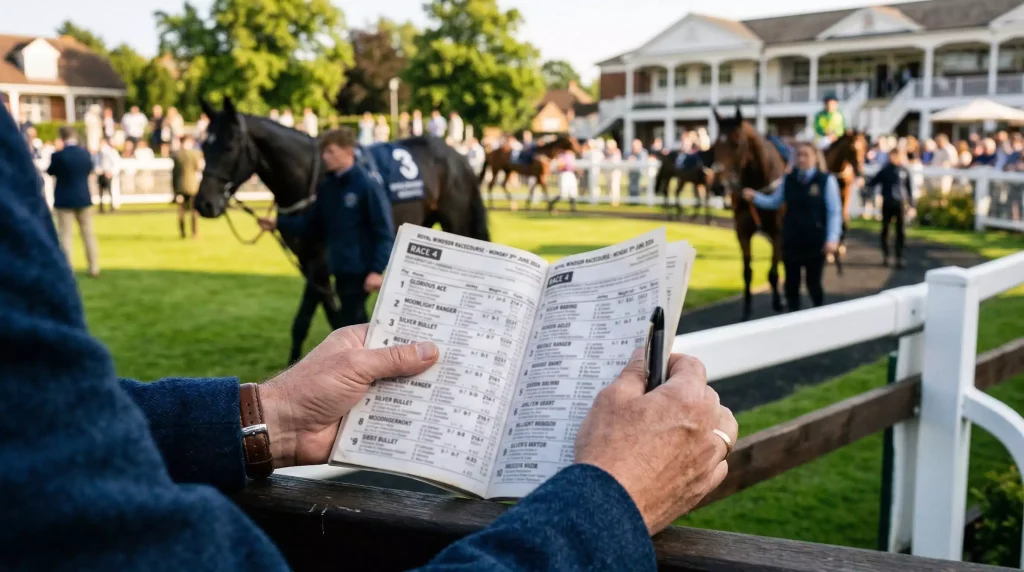
A horse racing result is not just a finishing order. Every line in a results sheet contains ten or more data points — the weight carried, the distance beaten, the starting price, the going description, the jockey, the trainer, the form figures — and each one tells you something about what happened in the race and what might happen next time. Learning how to read horse racing results is the single most useful skill a new punter can develop, because the results page is where every future assessment begins.
This guide uses examples from Windsor racecourse to explain each element of a race result and a race card, from the simplest — who finished first — to the more nuanced — what the starting price reveals about market confidence, and why the going report can flip the form book on its head. Windsor is an ideal case study because its compact calendar of twenty-six fixtures and its distinctive figure-of-eight layout generate results that reward close reading. The patterns are consistent, the biases are well documented, and the Monday-night cards produce a recurring stream of data that makes form analysis accessible even for beginners.
Results tell a story — once you know how to read them. What follows is a field-by-field guide to every column on the page, followed by the context that turns raw data into genuine understanding.
Anatomy of a Race Result: What Every Column Means
Open any results page — the Racing Post, Timeform, the course’s own website — and you will see a table with a row for each runner. The columns vary slightly between providers, but the core information is always the same. Here is what each field means and why it matters.
Finishing position is the obvious starting point. The numbers 1st, 2nd, 3rd and so on tell you the order in which horses crossed the line. If a horse is marked PU (pulled up), F (fell), or UR (unseated rider), it did not complete the race. If marked NR, it was a non-runner and did not start. The finishing position is the foundation of everything else — but taken alone, it tells you very little about how the race unfolded.
Distance beaten is the gap between each horse and the one in front. It is expressed in lengths — a length being roughly the distance from a horse’s nose to its tail — and fractions: a neck, a short head, a head, half a length. If the winner beat the second horse by three lengths, that is a comfortable margin. If the gap is a short head, the race was desperately close. At Windsor, where the home straight runs five furlongs, even a three-length margin can narrow to nothing over the final furlong if the front-runner tires.
Weight carried is listed in stones and pounds (the traditional British system) and represents the total load the horse bears, including the jockey, saddle, and any additional lead weights. In a handicap, the weight is assigned by the official handicapper to equalise the field; in a conditions race, it is determined by the race’s rules, often based on age or sex. The weight tells you how hard the horse had to work: carrying 9st 7lb is significantly easier than carrying 10st 2lb, and the difference can amount to several lengths over a mile.
Official rating (OR) is a number assigned by the BHA handicapper that reflects the horse’s estimated ability. The higher the number, the better the horse. Handicap races are restricted to horses within a certain rating band — a Class 4 handicap at Windsor might be for horses rated 0 to 75 — and the rating determines how much weight a horse carries. A horse rated 75 carries more weight than one rated 60 in the same race. The official rating is crucial for assessing whether a horse is well-treated (asked to carry less weight than its ability suggests) or harshly treated (carrying more than its form warrants).
Going describes the state of the ground, and it is displayed in the race header rather than in each horse’s row. The going scale runs from firm (fast, dry surface) through good to firm, good, good to soft, soft, and heavy (deep, saturated surface). At Windsor, summer evening cards typically run on good to firm, and winter jump meetings on soft. Going affects everything: speed, stamina demands, draw bias, and the type of horse that will perform best. A horse that loves fast ground may struggle on soft, and vice versa.
Starting price (SP) is the odds at which the horse was priced when the race started. It reflects the collective opinion of the betting market about the horse’s chances. A short SP — say, 2/1 — means the market thought the horse had a strong chance. A long SP — 33/1 — means the market considered it unlikely to win. SP is essential for assessing value: if you think a horse has a better chance than its SP implies, you have found a potential bet.
Jockey and trainer are listed for each runner. Over time, these names become a form factor in their own right. A horse trained by a specialist Windsor yard and ridden by a jockey with a high course strike rate is in a more favourable position than one sent by an unfamiliar trainer from the other end of the country. The jockey column also tells you about riding patterns: certain jockeys are known as front-runners, others as patient hold-up riders, and that style interacts with Windsor’s strong pace bias.
Form figures are a shorthand record of the horse’s recent finishing positions. A sequence like 1-3-2-5 means the horse won its last race, finished third the time before, second before that, and fifth in its fourth-most-recent outing. The figures are read right to left — the most recent run is on the right. Letters in the sequence have specific meanings: 0 means finished outside the first nine, F means fell, P means pulled up, and a dash separates different seasons. Reading form figures quickly is a skill that improves with practice, and it is the fastest way to get an overview of a horse’s recent trajectory.
Starting Price (SP) and What It Tells You
The starting price is one of the most misunderstood numbers on a results page. Many beginners treat it as a prediction — the shorter the price, the more likely the horse is to win — and while that is broadly true, the SP is really a reflection of where the money has gone rather than an objective probability. It is a market price, shaped by supply, demand, and the collective intelligence (and sometimes the collective error) of thousands of bettors.
The distinction between early prices and SP matters at a course like Windsor. Bookmakers publish their initial odds hours before a race, sometimes the night before. Those early prices reflect preliminary assessments. As money flows in through the morning, the afternoon, and the final minutes before the off, the odds shift. The starting price is the snapshot at the moment the stalls open. A horse that opens at 10/1 in the morning and drifts to 16/1 by the off is one the market has cooled on — perhaps because of a negative jockey booking change, an adverse going report, or simply a lack of buyer interest. A horse that opens at 10/1 and contracts to 5/1 is one the market is increasingly confident about.
Reading SP in the context of results tells you whether the market got it right. If the 2/1 favourite wins, the market was accurate. If a 25/1 outsider wins, the market misjudged — and that result is more informative than the obvious one, because it suggests something in the race (the draw, the pace, the going) was undervalued. Over a season of Windsor Monday-night cards, tracking which SP brackets win most often reveals whether the market systematically overprices favourites or underprices outsiders at the course.
The jockey’s riding fee adds financial context that most casual punters overlook. The Professional Jockeys Association sets riding fees at £173.54 per ride for flat jockeys in the 2026/26 season and £235.90 for jump jockeys. On top of this, flat jockeys receive approximately 7 per cent of prize money for a win, while jump jockeys take roughly 9 per cent. These numbers mean that a jockey riding in a Class 4 flat handicap at Windsor — where the winner’s share might be a few thousand pounds — earns a relatively modest return. In a listed race or the Winter Hill Stakes, the percentages become significant. The financial incentive for a top jockey to ride at Windsor is higher on feature days, which is why the jockey bookings on big cards are often more informative than those on routine Monday evenings.
Going: How Ground Conditions Shape Results
Going is the single most influential variable in horse racing results after the quality of the horses themselves, and at Windsor it carries particular weight because of the course’s geography. The going description appears in the race header — “Going: Good to Firm” or “Going: Soft” — and it applies to every race on the card, though conditions can change between the first and last race if rain falls during the evening.
The scale runs through seven main descriptions: firm, good to firm, good, good to soft, soft, heavy, and the rarer combinations like good to firm in places. Firm ground is fast and dry, favouring horses with a quick, low action. Heavy ground is deep and energy-sapping, favouring horses with stamina and a higher knee action. Most Windsor flat fixtures run on good to firm during the summer months, which means the results from those cards are the most comparable to each other. Winter jump meetings typically run on soft ground, which is a different test entirely.
“Proximity to the Thames gives us excellent drainage,” Mark Spincer, Managing Director of ARC’s racing division, has noted. “Our records show that fixtures on heavy ground have been rare — most abandonments have been due to frost rather than waterlogging.” That drainage advantage means Windsor rarely encounters the extreme going conditions that can cause havoc at lower-lying inland courses. For beginners, this consistency is helpful: the going at Windsor is more predictable than at most tracks, and the results data from one summer card is broadly applicable to another.
When reading results, the going tells you whether to take the form at face value or adjust it. A horse that won easily on soft ground may not reproduce that form on good to firm, because the surface demands different physical attributes. Conversely, a horse that ran poorly on firm ground might improve dramatically if the going eases. The form figures alone do not distinguish between these scenarios — only the going report does. At Windsor, this matters more than at many tracks because the five-furlong home straight — with its gentle elbow three furlongs from the finish — amplifies the effect of going on pace: soft ground saps the speed of front-runners over that extended run-in, while fast ground protects them. Checking the going for each of a horse’s previous runs, and comparing it with the going forecast for today, is one of the most basic but effective form-reading habits.
Handicaps, Classes and Race Types
Every race in Britain is assigned a class, from Class 1 (the highest quality) down to Class 7 (the lowest). The class appears in the race header alongside the distance, the going, and the prize money. Understanding it is essential because a horse’s form in a Class 5 race tells you almost nothing about how it would perform in a Class 3 — the quality gap between those levels is enormous, even though the horses might look identical to the untrained eye.
Windsor’s regular programme sits primarily in the Class 3 to Class 5 range. The Winter Hill Stakes is a Class 1 event (Group 3), the listed races are Class 1 (Listed), and the Sprint Series qualifiers range from Class 2 to Class 4. A typical Monday-night card at Windsor features five or six races in the Class 4 to Class 5 bracket, with the occasional Class 3 handicap providing a step up in quality. Reading the class correctly helps you understand the competitive context: a horse winning a Class 5 maiden is not necessarily talented, just better than a weak field. A horse winning a Class 3 handicap has beaten genuinely competitive opposition.
Handicaps are the most common race type at Windsor and across British racing generally. In a handicap, the official BHA handicapper assigns each horse a weight based on its assessed ability. The best horse in the race carries the most weight; the weakest carries the least. The goal is an equal contest where every horse theoretically has the same chance. In practice, horses whose ability is improving faster than the handicapper has recognised will be well-treated — carrying less weight than they deserve — and these are the runners that tend to win at rewarding prices.
Non-handicap race types include maiden races (restricted to horses that have never won), novice races (restricted to horses that have won no more than once or twice), conditions races (where weights are set by fixed rules rather than by the handicapper), and pattern races (Listed, Group 3, Group 2, Group 1 — the elite tier). Each type has its own dynamics, and comparing form across types is unreliable: a horse’s performance in a maiden tells you very little about how it will handle a competitive handicap.
Prize money adds context. Total prize money for British racing in 2026 reached a record £194.7 million, according to the BHA Racing Report. At Windsor, prize money ranges from around £5,000 for a low-class maiden to £70,000 for the Winter Hill Stakes. The purse level signals how seriously connections take the race: a horse entered in a race worth £30,000 is being targeted more deliberately than one entered in a race worth £5,000. For punters, higher-value races tend to produce more reliable form, because the stakes attract better-prepared horses and more experienced jockeys.
Non-Runners, Withdrawals and Reserves
Non-runners are horses that were declared for a race but did not start. They are marked NR in the results and in the betting. The reasons vary: injury, illness, unsuitable going, a trainer’s late decision, or a veterinary inspection at the course that flags a concern. Non-runners are a routine part of racing — most cards at Windsor have at least one — but their impact on the remaining field is often underestimated by beginners.
The most significant effect is on the draw. If a horse drawn in stall eight is a non-runner in a twelve-runner sprint, the remaining horses do not shift to fill the gap. Stall eight stays empty, and the horses drawn on either side of it have slightly more room. In a race where draw bias is a factor — a sprint on soft ground at Windsor, for example — a non-runner in a key stall can change the tactical picture. Checking the non-runner list before the race is a basic but often-skipped step.
Non-runners also affect the betting market. When a horse is withdrawn, bets placed on it are voided, and the remaining odds are adjusted through a deduction known as Rule 4. The size of the deduction depends on the price of the non-runner: if a 2/1 favourite is withdrawn, the deduction is substantial; if a 33/1 outsider drops out, it is minimal. For punters who have already placed their bets, a Rule 4 deduction reduces the payout. For those who have not yet bet, a non-runner can create value elsewhere in the field by removing a genuine contender.
Withdrawals can happen before the final declaration stage — typically forty-eight hours before the race — or on the day itself. Late withdrawals are more informative because they suggest a problem that has emerged after the horse was already committed: a bruised foot in the morning, an adverse going report, or a trainer’s last-minute change of plan. Reserves — horses on a waiting list to enter if a declared runner drops out — are relevant in handicaps where fields are limited by safety regulations. At Windsor, the maximum field size varies by distance and is set by the course’s safety certificate.
Putting It Together: Reading a Full Windsor Race Day
The best way to consolidate everything above is to walk through a full day of results from a single Windsor meeting. Pick any Monday-night card from the summer — the course stages twenty-six fixtures a year, thirteen of which are consecutive Monday evenings — and read the results from the first race to the last as a connected sequence rather than a set of isolated events.
Start with the going. The going report at the top of the card tells you the baseline surface condition. On a typical summer Monday, that will be good to firm. Note it, and then check whether the going changed during the evening — the final race header might read “Good to Firm, Good in places” if the ground has softened after rain. That shift affects how you interpret the later results compared with the earlier ones.
Then read each race in order. For the first race, look at the finishing order, the distances between each horse, the starting prices, and the form figures of the placed horses. Ask simple questions: did the favourite win? If not, why not — was it drawn badly, did it race from the rear on a pace-biased track, or was the going against it? Did a front-runner dominate the home straight? If the first race is a six-furlong sprint and the winner led from gate to post, that is an early signal that the pace bias is in play on this card.
By the third or fourth race, you have accumulated a picture. If front-runners have won two of the first three races, that tells you something about how the track is riding — the long straight is protecting leaders, and the going is fast enough to sustain early speed. If hold-up horses have prevailed, the ground may be riding slower than the official going suggests, or the fields have been genuinely competitive enough to put pressure on leaders. Either way, the earlier results on the card are the best possible guide to the later ones.
Look for patterns in the jockey and trainer columns. If a particular jockey has ridden two winners from three rides on the card, that jockey is in form and is reading the track well. If a trainer has runners in three races and the first two have run below market expectations, the third might be worth opposing. These within-card patterns are invisible if you only look at a single race in isolation — they emerge only when you read the full day as a continuous narrative.
Finally, note anything unusual. A non-runner in a key stall, a dramatic late drift in the betting, a horse that was pulled up without obvious cause — these details are the footnotes that the casual reader skips but the attentive one files away. Results are not just records of what happened. They are the raw material for what you will do next time. Every Windsor card generates data, and the punter who reads that data most carefully is the one who wins most often. The results tell a story, every evening, every furlong. All you have to do is learn to read it.