
Windsor Jump Racing Returns: Timeline, Results and the Figure-of-Eight Revert
Best Horse Racing Betting Sites – Bet on Horse Racing in 2026
Loading...
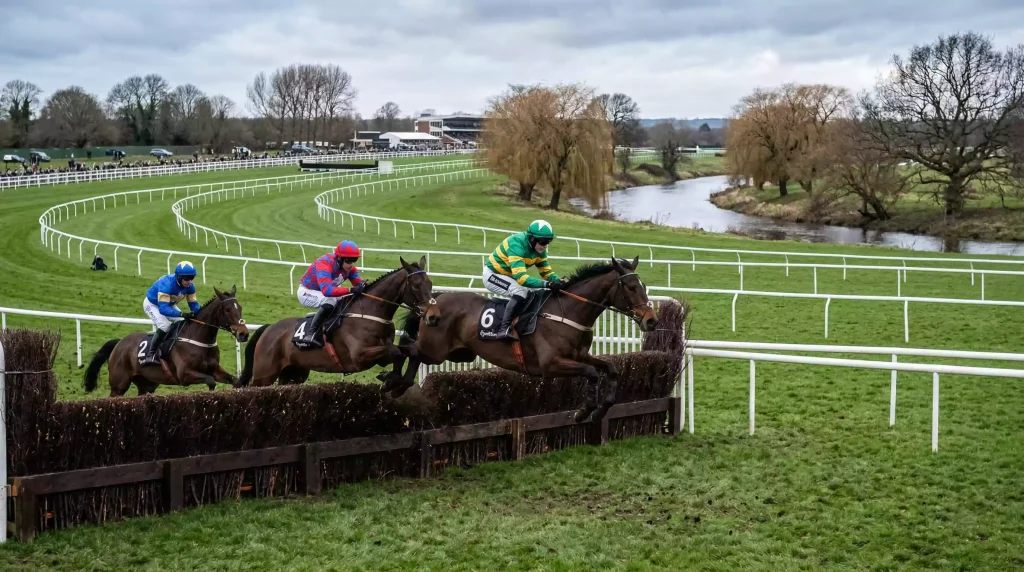
On 15 December 2026, a mare called Ma Shantou crossed the line first at Royal Windsor Racecourse under jockey Harry Cobden, trained by Emma Lavelle. It was a routine National Hunt victory in most respects — except that it was the first jump race at Windsor in approximately twenty years. Regular National Hunt fixtures had ceased in 1998, and for a generation of racegoers, Windsor meant flat racing, summer evenings, and little else between October and March.
The return of windsor jump racing results to the calendar was not a sudden decision. It was the culmination of a process that began with a formal announcement by Arena Racing Company in 2023, continued through infrastructure investment and BHA consultations, and took its first physical form on that December afternoon. What followed — a debut season, a course configuration change, a new winter festival — amounts to the most significant transformation of Windsor’s racing identity in decades.
This is the full timeline of that transformation: the reasoning behind the decision, the practicalities of making it happen, the results from the opening season, and the pivotal switch back to the figure-of-eight. Twenty years in the making, delivered in two.
The Decision: 2023 Announcement
The formal announcement came in 2023, when Arena Racing Company confirmed that jump racing would return to Royal Windsor for the 2026/25 season. The decision was not impulsive. ARC had been evaluating the feasibility for some time, and the key obstacle was always the same: could the course’s turf sustain National Hunt racing through the winter months without deteriorating to the point where fixtures would be abandoned?
The answer lay partly in geography and partly in investment. Windsor sits on its own 165-acre island in the Thames, and that proximity to the river provides natural drainage that most inland courses cannot match. “We have long wanted to bring jump racing back to Windsor and are delighted to confirm our plans well ahead of the first fixture in December 2026,”
said Mark Spincer, ARC’s Managing Director of Racing, when the return was announced. ARC backed the ambition with capital: new drainage systems were installed, and previously unused grassed areas of the island were prepared and maintained specifically for jump racing use.
The investment was deliberate rather than lavish. ARC was not building a new racecourse — it was reactivating capability that had lain dormant. The existing infrastructure (grandstands, stabling, access roads) was already in place from the flat programme. What was needed was jump-specific work: portable fences, hurdle flights, ground that could handle hooves at pace on soft winter turf. The drainage work, capitalising on the Thames-side location, was the centrepiece of that preparation. Unused grassed areas were brought into racing condition over a period of months, a process that involved reseeding, levelling, and installing subsurface drainage channels to complement the natural water table.
The BHA signed off on the plans, and Windsor was granted its jump licence ahead of the 2026/25 season. The course had cleared the administrative and practical hurdles. What remained was to see whether the product — the racing itself — would justify the effort.
Season One: December 2026 Debut
The first National Hunt fixture took place on 15 December 2026 — a Sunday card that drew considerable attention from the racing press and a crowd keen to see whether the theory would translate into practice. Ma Shantou, trained by Emma Lavelle and ridden by Harry Cobden, became the first jump winner at Windsor in roughly two decades. It was a fitting start: Lavelle trains in the region, Cobden is one of the top National Hunt jockeys in the country, and the horse handled the winter ground without complaint.
Nicky Henderson, six-time champion jump trainer, had endorsed the return publicly. “This is seriously good news for National Hunt racing. I remember when they used to have jump racing there. The ability to provide good ground in the winter is a particular advantage,”
Henderson told the Racing Post. His words carried weight. Henderson has spent a career identifying which courses suit which horses, and his willingness to speak positively about Windsor’s jump prospects was a signal to other trainers that this was worth taking seriously.
The debut season comprised a small number of fixtures — three in total — run on a left-hand oval configuration rather than Windsor’s traditional figure-of-eight layout. This was a pragmatic choice for the first year, allowing the course management to assess how the ground held up and how the fences played on a simpler track shape. The left-hand oval used existing turf that had been maintained but not raced on for years, and it avoided the complexity of navigating the crossover point that defines the figure-of-eight under jump conditions.
The feedback from trainers and jockeys after those three meetings was broadly positive, though there were suggestions that the left-hand oval did not fully exploit Windsor’s unique track design. Some felt that the oval, while safe and functional, produced races that could have been run at any number of left-handed courses across the south. The figure-of-eight, by contrast, would give Windsor a distinctive identity in the National Hunt calendar — much as it does for the flat. Those suggestions would prove consequential.
The Figure-of-Eight Revert: November 2026
From November 2026, Windsor reverted to its traditional figure-of-eight configuration for all jump racing, abandoning the left-hand oval used in the debut season. The safety factor for all jump races was set at 16 — the maximum permitted, reflecting the additional caution required when horses change direction mid-race on a crossing track. The decision was not cosmetic. It was a response to the constructive feedback received after the first three fixtures, and it came with veterinary backing.
Clive Hamblin, Senior Veterinary Surgeon at Windsor Racecourse and Veterinary Advisor to the National Trainers’ Federation, supported the change on biomechanical grounds. “Reverting to the figure-of-eight will improve the balance of horses’ stride, enhancing both the quality of galloping and jumping and reducing the risk of injury,”
Hamblin explained in the course’s announcement. The logic is intuitive if you understand the physics: a left-hand-only oval forces horses to load their left fore repeatedly through every bend, whereas the figure-of-eight distributes the turning load across both directions, giving the musculoskeletal system more varied demands.
Mark Spincer framed the revert as a natural progression. “We were delighted to bring jump racing back in 2026. After three fixtures we received a lot of positive and constructive feedback. We hope that reverting to the figure-of-eight will allow Windsor to continue offering competitive jump racing,”
he said in the official announcement. For punters studying windsor jump racing results, the revert has practical implications: draw bias data and pace patterns from the flat programme become partially applicable to jump races too, since the underlying track geometry is now the same. Front-runners on the long five-furlong home straight face the same advantages over fences as they do on the flat.
Nicky Henderson gave the change his public blessing. “The return of jump racing is an excellent initiative that we all want to support and make a success,”
Henderson told the Racing Post. When a trainer of Henderson’s stature endorses a course configuration, it tends to influence declarations — and the expectation is that Windsor’s jump cards will attract stronger fields on the figure-of-eight than they did on the temporary oval.
What’s Next: The 2026/26 Jump Calendar
The 2026/26 jump season at Windsor is built around two anchors: the Berkshire Winter Million in January and a regular programme of fixtures running from November through to early spring. The BWM, with its £1.25 million prize fund and three-day festival format, is covered in detail elsewhere — but its existence shapes the entire jump calendar. Trainers now have a reason to have horses fit and ready for Windsor by mid-January, which in turn creates demand for preparatory races at the course in November and December.
Beyond the BWM, the regular jump fixtures serve a different purpose. These are the bread-and-butter National Hunt cards — novice hurdles, handicap chases, conditional jockeys’ races — that build a course’s reputation for competitive racing and fair ground. Windsor’s Thames-side drainage means that abandonment due to waterlogging is rare, though frost remains the primary threat in deep winter. The twenty-six fixtures Windsor now hosts across both codes represent a significant increase in its calendar density, and the jump programme is where the growth potential lies.
The timeline from decision to delivery has been remarkably compressed: announcement in 2023, investment through 2026, debut in December 2026, configuration change in November 2026, flagship festival in January 2026. Twenty years in the making, perhaps, but executed in barely two. Whether Windsor’s jump identity matures into something permanent depends on what the results show over the next few seasons — but the infrastructure, the backing, and the early returns all point in the same direction.
For those following the results, the key is to treat Windsor’s jump data as a work in progress. Course form is still being established, track biases on the figure-of-eight under National Hunt conditions are only just becoming visible, and the going patterns through a full winter season have yet to be tested across multiple years. All of that means opportunity — for trainers willing to experiment with the course, for jockeys learning where the ground rides best, and for punters paying attention before the market catches up.