
Monday Night Racing at Windsor: Schedule, Themes and What to Expect
Best Horse Racing Betting Sites – Bet on Horse Racing in 2026
Loading...
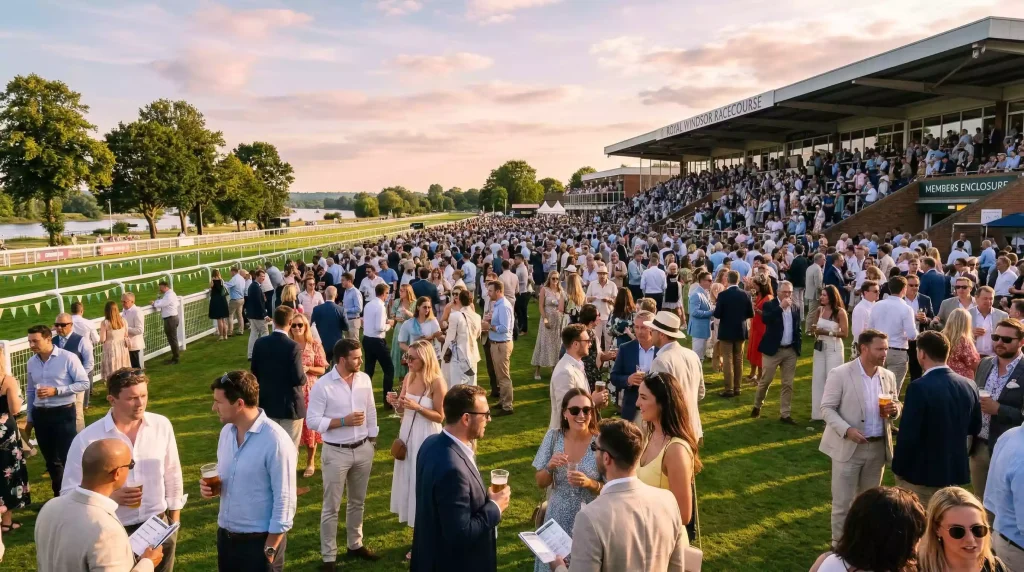
Thirteen consecutive Monday evenings, from April through September, make Royal Windsor the only racecourse in Britain running a regular weekly evening fixture across the entire flat season. Monday Night Racing is not a one-off promotional gimmick — it is a structural feature of the Windsor calendar, accounting for half of the course’s twenty-six annual fixtures and drawing a crowd that blends serious punters with casual visitors who might not set foot on a racecourse any other day of the week.
What makes these evenings distinctive is the combination of competitive racing and event-style atmosphere. The cards typically feature six or seven races across Classes 3 to 5, run on the figure-of-eight track under evening light, with themed entertainment layered around the programme. For those tracking windsor monday night racing results, the patterns are worth understanding: the going tends to ride faster as summer dries the turf, apprentice jockeys appear more frequently in the lower classes, and the pace bias that defines Windsor during the day applies with equal force under the Berkshire sky.
The Format: Gates, Race Times and the Evening Card
Gates typically open in the mid-afternoon, with the first race going off between approximately 4:30 PM and 5:45 PM and the final race scheduled for around 8:00 PM to 8:45 PM depending on the month. The exact times shift across the season — earlier in April and later at the height of summer when daylight allows — but the core window remains consistent. Six to eight races per card is standard, and the class distribution favours the middle of the pyramid: Class 3 and Class 4 handicaps form the backbone, with occasional Class 5 races and the odd conditions event to vary the texture.
The race distances lean toward sprints and middle distances. Five-furlong and six-furlong dashes are the most common, which suits Windsor’s almost-straight sprint course and plays directly into the track’s established draw and pace biases. Mile races appear on most cards too, routed through the right-hand-only section of the figure-of-eight where low stalls carry a measurable advantage on certain going. The fields tend to be healthy — twelve to sixteen runners in the handicaps is typical during the summer months — which creates competitive markets and genuine unpredictability.
From a punter’s perspective, the evening format introduces a specific variable: the going can change perceptibly between the first and last race. Summer evenings at Windsor often start with good-to-firm ground that rides faster as the moisture evaporates through the afternoon. Horses drawn wide in sprint races early on the card may face different conditions to those running three hours later. It is a minor factor, but for anyone studying form seriously, the timing of each race relative to the going stick matters more than it would at a lunchtime fixture. The racing, then, has its own character — and so does the evening around it.
Themed Nights: Soul and Motown to ABBA
The themed evenings are what distinguish Monday Night Racing from a standard flat fixture. Windsor programmes live entertainment alongside the racing: Soul and Motown nights, Rum and Reggae evenings, an ABBA tribute act, and similar. The entertainment runs in the enclosures between races, creating a festival-lite atmosphere that feels closer to a summer music event than a traditional raceday. Whether that appeals to you depends on what you want from the evening — serious form students might find the noise distracting, while casual visitors rate it as part of the experience.
The themes rotate across the thirteen-week run, so no two consecutive Mondays offer the same entertainment package. This is deliberate: Windsor wants repeat visitors, and varying the evening’s character gives people a reason to come back. The themed nights also attract a younger and more diverse audience than the average midweek fixture. Families are catered for on certain evenings, with children’s entertainment in designated areas, while others are pitched more firmly at adult groups and corporate bookings.
From a racing standpoint, the themes have no impact on the card itself — the BHA programmes the races, not the entertainment team — but they influence the crowd size and composition. Themed evenings tend to draw larger attendance than non-themed cards, which in turn affects the betting pools and on-course atmosphere. A packed Monday with a Soul night will feel markedly different to a quieter early-April opener, even if the quality of the racing is comparable. For those studying results, the crowd factor is background noise; for those planning a visit, it is the main attraction.
How Results Differ on Monday Evenings
The racing at Monday Night meetings follows the same rules as any other fixture, but the competitive dynamics have their own flavour. The class distribution — predominantly Class 3 to 5 — means that many runners are exposed handicappers rather than unexposed improvers. Trainers often target these evenings with horses that handle the course’s peculiarities, and course form carries extra weight in the results. A horse with previous Monday evening form at Windsor is a more reliable guide than one transferring from a left-handed oval with a different track profile.
Apprentice jockeys appear more frequently on Monday evening cards than on higher-class weekend fixtures. In Class 4 and Class 5 handicaps, the weight allowance an apprentice claims can be decisive — particularly over five and six furlongs, where a three-pound or five-pound swing matters over a short distance. The Monday Night results reflect this: outsiders ridden by claiming jockeys hit the frame more often than the market implies, especially in the lower-class races later on the card.
The pace bias that defines Windsor’s flat programme applies on Monday evenings with the same force it does at any other meeting. Across all distances at the course, front-runners win roughly four times as often as horses held up for a late run. That ratio does not soften because the sun is lower or the crowd is louder. If anything, the evening going — which tends to ride on the quicker side of good during summer — amplifies the advantage, because faster ground favours horses who can maintain a high cruising speed without the ground sapping their stamina in the closing stages.
Planning Your Evening: Practical Tips
Windsor is well connected for an evening visit. The racecourse sits just off the M4 corridor, with on-site parking that fills quickly on themed nights — arriving an hour before the first race is advisable if you want a spot close to the entrance. Windsor and Eton Riverside station is a short walk from the course, and the return trains to London Waterloo run late enough to catch the last race comfortably. For those driving from London, the journey is typically under an hour outside peak traffic, though the M4 westbound can be unpredictable on summer Mondays.
Dress code at Monday Night Racing is relaxed compared to weekend fixtures or festival days. Smart casual is the norm across the enclosures, and there is no strict enforcement of jacket-and-tie rules in the main areas. The atmosphere is informal by design — this is racing under the Berkshire sky, not Royal Ascot — and the course encourages visitors to treat it as an evening out rather than a formal occasion.
Food and drink options range from on-course bars and street-food stalls to pre-booked hospitality packages. The street-food offering has expanded in recent years and typically varies by theme night, so a Rum and Reggae evening might feature Caribbean-influenced options alongside the standard racecourse fare. Bringing a picnic is permitted in certain enclosures, which remains one of the better-value ways to enjoy the evening if the weather cooperates. Check the course website for specific policies on each meeting, as arrangements can vary across the season.