
Figure-of-Eight Racecourses: Comparing Windsor and Fontwell Park
 Available in US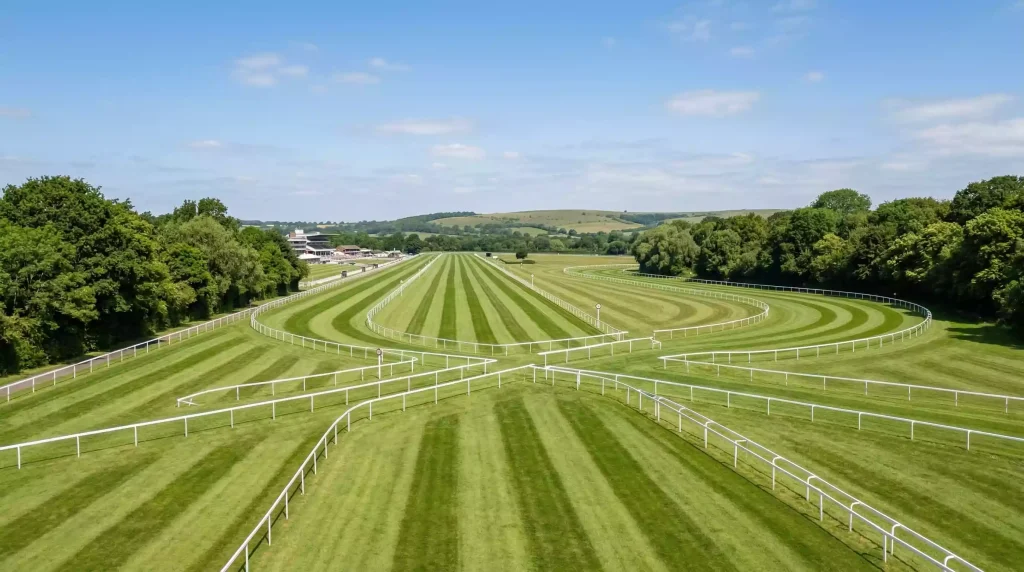
Britain has sixty racecourses. Only two use a figure-of-eight layout: Royal Windsor in Berkshire and Fontwell Park in West Sussex. The shared track shape invites comparison, and punters occasionally treat form at one as relevant to the other. It usually is not. The two courses differ in size, surface, codes, going patterns, and the fundamental racing dynamics that the figure-of-eight creates at each venue. Same shape, different races — and understanding the differences matters more than recognising the similarity.
This is a point-by-point comparison: layout, codes, going, and what the differences mean for anyone assessing form across both venues.
Figure-of-Eight Track Layouts and Distance Dimensions
Windsor’s full circuit measures just over one mile and four furlongs, with two loops that cross at a central point and a five-furlong home straight on the eastern side. The track is broad, the bends are relatively gentle, and the crossing point sits far enough from the finish that horses have time to re-establish rhythm after the direction change. The sprint distances — five and six furlongs — run almost entirely straight, bypassing the figure-of-eight complexity altogether. The overall feel is spacious: there is room for a field of sixteen to spread across the track without overcrowding on the bends.
Fontwell Park is smaller and tighter. The figure-of-eight is used exclusively for hurdle races, with the chase course running on a separate conventional layout. The hurdle circuit has sharper bends, shorter straights, and a crossing point positioned closer to the finish than Windsor’s. The home straight at Fontwell is significantly shorter, which means that the race is often decided on the final turn rather than in a sustained run to the line. The overall impression is of a nimbler, more compact track that asks different questions of horse and jockey — agility and acceleration matter more at Fontwell, while stamina and sustained pace matter more at Windsor.
The dimensional difference has direct consequences for race dynamics. Windsor’s long straight rewards horses who can sustain a gallop over five furlongs without the stimulus of a bend to maintain momentum. Fontwell’s shorter straight rewards horses who can accelerate out of the final turn and maintain that burst for a furlong and a half. The two tracks select for different physical and tactical qualities, which is the primary reason that form does not transfer reliably between them. A horse that sits behind the leaders at Fontwell and quickens from the last bend is using a skill that Windsor’s long straight does not reward in the same way.
Codes and Race Types
Windsor is a dual-code racecourse. Its flat programme runs from April to September, covering Classes 2 through 5 with the Winter Hill Stakes (Group 3) as the flagship event. Since December 2026, it has also hosted National Hunt fixtures, and from November 2026, jump racing has been run on the figure-of-eight configuration rather than the temporary left-hand oval used in the debut season. The safety factor for jump races on the figure-of-eight is set at 16, the maximum permitted.
Fontwell is jump-only. There is no flat programme, no summer evening meetings, no draw bias to consider. The figure-of-eight at Fontwell is reserved for hurdle races; the chase course is a separate conventional left-handed oval. This means that Fontwell’s figure-of-eight form is exclusively National Hunt, while Windsor’s figure-of-eight form spans both codes — a distinction that matters when assessing a horse’s track experience.
A horse with figure-of-eight form at Fontwell has demonstrated the ability to handle direction changes over hurdles on a tight, sharp track. That tells you something about its agility and jumping technique, but it does not tell you how it will cope with Windsor’s broader layout, longer straight, or the specific going conditions of a Thames-island course. The codes overlap in the abstract — both are National Hunt, both use a crossing — but the physical demands are different enough to warrant caution in translating form.
Going and Ground
Windsor’s going is shaped by the Thames. The island location provides natural drainage that keeps the ground more predictable than at most courses — heavy ground is rare, and the going typically ranges from good (summer flat) to soft (winter jump). The drainage infrastructure, supplemented by ARC’s investment ahead of the jump racing return, means that fixtures are rarely abandoned due to waterlogging. Frost is the primary threat to winter meetings.
Fontwell sits on Sussex chalk, which produces a different drainage profile. Chalk is porous, so Fontwell also drains well, but the surface can become firm more quickly in dry weather and can turn slippery on the tight bends when the ground is genuinely soft. The going at Fontwell tends to be more variable within a single meeting — the bends take more traffic and ride differently to the straights — which creates localised ground variations that do not map onto Windsor’s more uniform surface.
Seasonal patterns differ too. Windsor’s flat programme runs from April to September on good-to-firm or good ground, with the jump programme occupying the winter months on soft or softer going. Fontwell races year-round through the jump season, typically from October to May, with the going varying widely — from good-to-soft in autumn to heavy in midwinter. The contrast means that a horse with Fontwell form in January may have encountered conditions significantly different from those at Windsor’s winter jump meetings, even if both are officially described as “soft.”
For punters, the going comparison reinforces the broader message: a horse that acts on soft ground at Fontwell may handle soft at Windsor, but the surface characteristics are not identical. The Thames-side ground at Windsor tends to ride slightly better than its official description suggests, while Fontwell’s chalk-based turf can ride slightly worse than the going stick indicates on the turns. Adjusting expectations by a notch in either direction is a practical rule of thumb when comparing going data between the two.
What the Comparison Means for Punters
The central message is simple: figure-of-eight form at one course is not figure-of-eight form at the other. The tracks share a shape but not a character, and treating them as interchangeable leads to flawed assessments. A horse that wins convincingly at Fontwell’s hurdle figure-of-eight may be entirely unsuited to Windsor’s broader, longer version of the same layout — or it may thrive. The point is that you cannot assume the transfer; you must treat each course’s form as independent data that requires its own evaluation.
Draw bias exists only at Windsor, and only for the flat programme. Fontwell has no stalls, no draw, and no sprint races — the entire comparison occurs in the National Hunt sphere, where starting positions are self-selected rather than assigned. For flat punters, Fontwell form is irrelevant. For jump punters, Fontwell form is relevant only to the extent that it demonstrates a horse’s willingness to change direction mid-race, which is a transferable quality. Everything else — the going, the track speed, the home straight, the tactics — requires Windsor-specific data.
Same shape, different races. The figure-of-eight is a category, not a guarantee of comparable conditions. Treat the two courses as what they are — distinct venues that happen to share a geometric label — and your form analysis will be sharper for it.
