Windsor Racecourse History: From 1866 to the Modern Track
 Available in US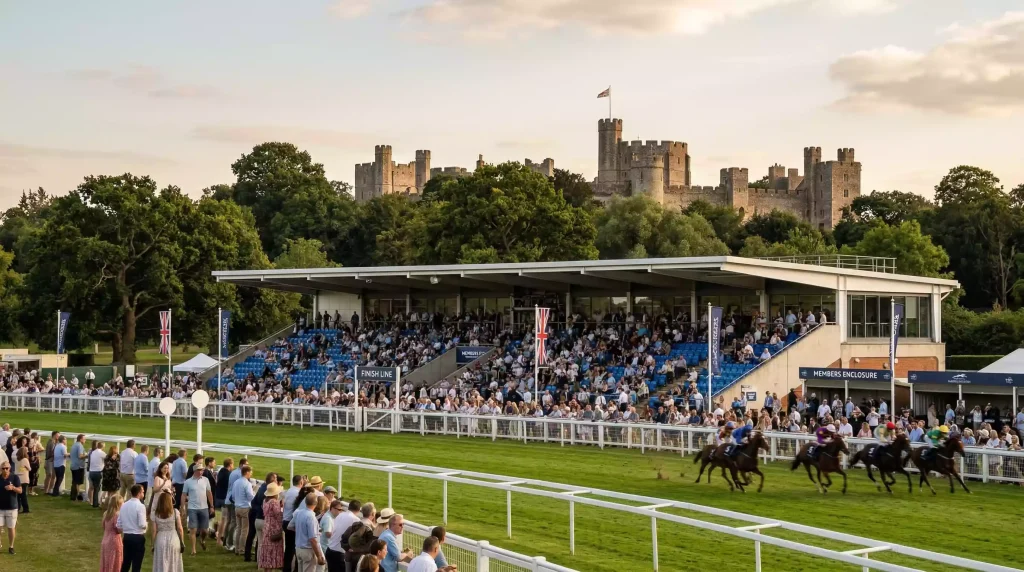
Windsor Racecourse has survived two world wars, a German flying bomb, a bookmaker strike orchestrated in response to Winston Churchill’s tax policy, and a twenty-year absence of jump racing. It is, by any measure, a racecourse that survived a flying bomb — and rather more besides. The course occupies a 165-acre island in the Thames, a location it has held since organised racing began there in the mid-nineteenth century, and its history reflects the broader arc of British racing through periods of expansion, contraction, war, and reinvention.
This is the full timeline: from Victorian origins through the conflicts of the twentieth century to the modern era of ARC ownership, figure-of-eight racing, and the return of National Hunt competition in 2026.
Windsor Racecourse Origins and Victorian Era History
Racing at Windsor dates to at least the 1860s, with the course established on the island site that it still occupies. The Thames location was not incidental — the island offered a natural enclosure that could be controlled for admission purposes, with bridges providing the only access points. This geographical advantage made it easier to manage crowds and collect gate money, a practical consideration that shaped many early racecourse locations in an era before sophisticated ticketing.
The Victorian course was smaller and simpler than the modern layout, with racing conducted on a more conventional track before the figure-of-eight configuration was developed. The island setting, with its natural drainage and proximity to Windsor town, made it a viable year-round venue — though the flat-racing calendar of the period was shorter and less structured than today’s programme. The going was determined entirely by weather and season, without the benefit of modern irrigation or drainage systems, which meant that winter meetings on the heavy Thames-side turf were a different proposition to the quicker ground of summer.
The Royal connection — Windsor Castle sits barely a mile from the racecourse — gave the venue a social prestige that attracted both the racing establishment and the broader public, establishing a dual identity as both a serious racing venue and a social occasion that persists to this day. Royal patronage was not formal in the way it is at Ascot, but the proximity lent the course an association with the Crown that elevated its standing above many provincial tracks of similar size.
By the turn of the twentieth century, Windsor had established itself as a regular fixture in the southern racing calendar, with a programme that included both flat and jump racing — a dual-code identity that would be severed in 1998 and not restored until 2026.
Wartime Racing and the V1 Incident
Windsor was one of only three southern racecourses — alongside Newmarket and Salisbury — that continued to stage racing during both world wars. While many courses were requisitioned for military use, Windsor’s island location and proximity to London made it a viable venue for the reduced wartime programme. Racing continued under austere conditions: smaller fields, fewer meetings, restricted travel for spectators, and a general sense that the sport was carrying on as a morale exercise rather than a commercial enterprise.
The most dramatic wartime moment came in 1944, when a German V1 flying bomb landed near the racecourse during the preparation of horses for a race. The V1 — a pulse-jet cruise missile — was one of thousands launched at southern England in the final year of the war, and the fact that one struck close enough to the racecourse to disrupt proceedings underlines the risk under which wartime racing operated. Nobody was killed in the incident, but it remains one of the more remarkable footnotes in British racing history: a racecourse that took a flying bomb and kept racing.
The wartime era shaped Windsor’s identity as a resilient venue. While other southern courses closed for the duration, Windsor maintained a presence in the calendar — a point of continuity that connected the pre-war and post-war racing worlds and gave the course a claim to historical endurance that few British racecourses can match.
The Bookmaker Strike and Churchill
In 1926, the bookmakers at Windsor went on strike. The cause was Winston Churchill’s introduction of a betting tax — a levy on on-course wagers that the bookmaking community considered punitive and unworkable. The Windsor bookmakers refused to operate, forcing the day’s races to proceed without on-course betting — a surreal spectacle that drew national attention and contributed to the eventual withdrawal of the tax. It was a rare moment of collective industrial action in a trade not known for solidarity, and Windsor was its stage.
Three years earlier, in 1923, the course had produced another oddity: a triple dead heat, captured by the photo-finish camera in an era when such technology was still rudimentary. Three horses crossing the line simultaneously was unusual enough to make the sporting press of the day, and the photograph — grainy, contested, but officially decisive — became one of Windsor’s earliest claims to historical distinction.
Nicky Henderson, the six-time champion jump trainer, has spoken about remembering when jump racing was held at Windsor — a personal connection to the course’s earlier dual-code era that predates its 1998 closure to National Hunt. “This is seriously good news for National Hunt racing. I remember when they used to have jump racing there. The ability to provide good ground in the winter is a particular advantage,”
Henderson told the Racing Post. His endorsement carried the weight of someone whose memory of the course extends back to a period when it hosted both codes as a matter of routine rather than innovation.
Modern Era: From Jump Closure to Return
Regular jump racing at Windsor ceased in 1998, ending a tradition that had run in parallel with the flat programme for over a century. The reasons were commercial and practical: the course management at the time determined that the flat programme was more profitable and that the winter jump fixtures did not justify the maintenance costs of the jump track. For the next two decades, Windsor was a flat-only venue — summer evenings, the Winter Hill Stakes, and little else between October and March.
The modern era brought Arena Racing Company’s ownership and a gradual investment in the course’s facilities and programme. ARC introduced the Monday Night Racing format, which became Windsor’s signature offering — thirteen consecutive summer evenings that drew crowds larger than many weekend fixtures at other southern courses. The themed evenings, the accessible pricing, and the location within easy reach of London created a product that was part racing, part social event, and commercially successful enough to justify continued investment.
One of the more remarkable single-day achievements in Windsor’s flat-racing history came on 15 October 2012, when jockey Richard Hughes won seven of the eight races on the card — an extraordinary feat whose odds were estimated at 10,168 to 1. Hughes’ seven-timer became an instant part of Windsor lore and demonstrated the course’s capacity to produce headline moments even outside its Group-race programme. The day was a reminder that even a mid-tier provincial course can generate stories that transcend the usual racing narrative, given the right combination of talent and circumstance.
The announcement in 2023 that jump racing would return — followed by the first fixture in December 2026, Ma Shantou’s historic victory under Harry Cobden, and the figure-of-eight revert in November 2026 — brought the story full circle. Windsor was once again a dual-code racecourse, hosting twenty-six fixtures across flat and jump, and the Berkshire Winter Million gave it a winter festival that its Victorian founders could scarcely have imagined. The thread from the nineteenth century to the twenty-first is unbroken — a racecourse on an island, shaped by the Thames, defined by its figure-of-eight, and perpetually reinventing itself around those constants.
2026 and Beyond
The current era at Windsor is defined by reinvention. The jump racing return, the Berkshire Winter Million, the Venues of Excellence designation, the appointment of a new Executive Director — these are the markers of a racecourse that is actively reshaping its identity rather than coasting on its history. The twenty-six fixtures now spread across both codes give Windsor year-round relevance in the British racing calendar for the first time in a generation.
The figure-of-eight track remains the constant through every era. It is the feature that makes Windsor results distinctive, that creates the draw and pace biases punters study, and that gives the course a character no other British racecourse can replicate. From the Victorian pioneers who laid out the track on a Thames island to the ARC team now running jump races over fences on the same figure-of-eight, the thread is continuous. A racecourse that survived a flying bomb is unlikely to be troubled by the challenges ahead.
