
Windsor Figure-of-Eight Track Layout and Distance Quirks
 Available in US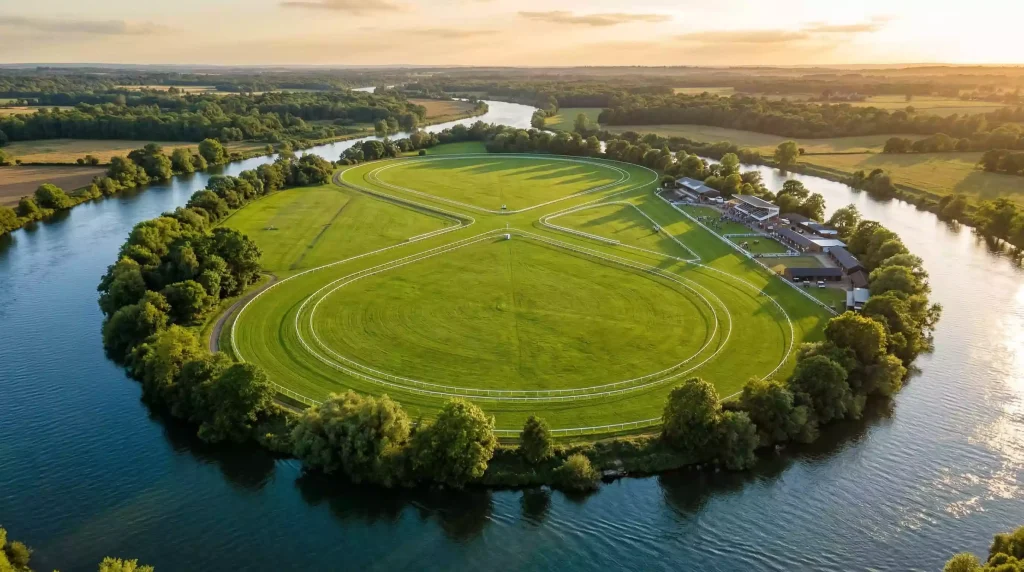
Windsor and Fontwell Park are the only two racecourses in Britain with a figure-of-eight track layout — two loops that cross at a central point, creating a course where horses change direction mid-race. That shared description is where the similarity ends. Windsor’s figure-of-eight is configured so that sprint races run almost entirely on the straight, middle-distance races route through right-hand-only bends, and only the longest distances use the full crossing. Understanding this windsor figure of eight course guide matters because it explains why results at Windsor often confound form from conventional oval tracks.
This is a topographical guide to the layout: two loops, one finish line, and the quirks that make each distance a different proposition.
Windsor Track Configuration: Inner Loop, Outer Loop, and Crossing
The full circuit at Windsor measures just over one mile and four furlongs — compact by British standards but deceptively complex in its geometry. The track comprises two loops: an inner loop on the north side and an outer loop on the south, connected at a crossing point roughly in the centre of the course. The finish line sits at the end of a long straight on the eastern side.
The crossing point is the defining feature. On races that use the full circuit, horses travel through the crossing twice — once heading away from the finish and once heading towards it. The direction change requires the field to adjust its line, and horses that lose momentum at the crossover or drift wide through the transition pay a tangible penalty in terms of ground covered. For jockeys unfamiliar with the track, the crossing can be disorienting — the instinct to follow the rail does not apply in the same way as it does on a conventional oval, because the rail leads in different directions depending on which loop the field is navigating.
The home straight runs for five furlongs on the eastern side of the course, with a slight bend — the elbow — approximately three furlongs from the finish. This is the longest home straight at any non-oval course in Britain, and it rewards horses who can sustain a gallop over a significant distance without the acceleration demands of a short run-in. Front-runners who are still travelling well at the elbow have a structural advantage, because the straight gives them room to defend their lead without the disruption of a final turn.
Distance by Distance: Where Each Race Runs
The five-furlong and six-furlong races are Windsor’s simplest in terms of routing. The six-furlong course runs almost entirely straight, with minimal curvature — essentially a dash from the start to the finish along the eastern straight. This near-straight configuration means that the draw has less influence than at tracks with tight bends at the start, though on soft ground the far side of the track (high stalls) can offer better footing. The five-furlong course uses the final five furlongs of the same straight, placing even more emphasis on break speed and early positioning.
At one mile and beyond, the routing changes fundamentally. The one-mile, one-mile-two-furlong, and one-mile-three-furlong-ninety-nine-yard races take the field through bends that turn exclusively to the right. There is no left-hand section on these distances — a rarity in British racing, where most courses include turns in both directions. This right-hand-only routing means that horses with a strong preference for right-handed tracks, or those who have raced predominantly at right-handed venues, may have an advantage that their form at left-handed courses would not reveal.
The home straight’s five-furlong length remains constant across all distances, and the elbow three furlongs from the finish is the key tactical point on middle-distance races. Horses that are well positioned on the inside rail at the elbow save significant ground compared to those racing wide. The elbow is not sharp enough to constitute a genuine bend, but on soft ground the slight camber creates a rail bias that favours the inner line. For punters, noting a horse’s position at the elbow on a replay is one of the most informative things you can observe.
Races at one mile four furlongs and beyond use the full figure-of-eight, navigating both loops and passing through the crossing point. These are the least common distances on the Windsor card but the most distinctive in terms of what the track demands: adaptability, balance through direction changes, and the stamina to maintain effort over a longer and more varied route.
Flat vs Jump Configuration
For the flat programme, the figure-of-eight has been the standard layout for decades. All flat races at Windsor use the same track geometry, with the distance determining which sections of the figure-of-eight are in play. The track surface is natural turf, maintained year-round with watering in summer and drainage support in winter.
The jump programme has a more complex recent history. When National Hunt racing returned to Windsor in December 2026, the first season’s fixtures were run on a left-hand oval — a simplified layout that avoided the crossing point entirely. From November 2026, Windsor reverted to the figure-of-eight for jump racing, with a safety factor of 16 applied to all races. The revert means that jump and flat races now share the same underlying track geometry, which has implications for form analysis: pace patterns, draw biases, and course knowledge accumulated from flat racing become partially applicable to the jump programme.
The fences and hurdle flights are positioned on the outer and inner loops, and horses jumping on the figure-of-eight must negotiate the crossing point between obstacles — a unique challenge in British jump racing that does not exist at any other course. Early feedback from trainers and jockeys has been positive, with the veterinary view supporting the figure-of-eight as biomechanically superior to the left-hand-only oval for jump racing.
Windsor vs Fontwell: Two Figure-of-Eights Compared
Fontwell Park in West Sussex is Windsor’s only fellow figure-of-eight in Britain, but the two courses are more different than alike. Fontwell is a National Hunt-only venue — no flat racing — and its figure-of-eight is used exclusively for hurdles, with the chase course running on a separate conventional layout. Windsor uses its figure-of-eight for both codes. Fontwell’s circuit is tighter and shorter, with sharper bends and a shorter home straight, producing a very different race dynamic: acceleration from the final turn matters more at Fontwell, while sustained pace through the long straight matters more at Windsor.
The crossing points differ in character too. Fontwell’s crossover is positioned closer to the finish, which means that horses navigate the direction change at a later stage of the race when fatigue is a factor. Windsor’s crossing sits more centrally, giving the field time to re-establish rhythm before the long run to the line. The different positioning alters the tactical demands — and therefore the type of horse that excels at each venue.
The practical consequence for form analysis is that course form at Fontwell does not transfer reliably to Windsor, and vice versa. A horse that handles Fontwell’s tight bends may struggle with Windsor’s more open layout and longer straight. The figure-of-eight label connects them, but the actual racing experience is distinct enough that they should be treated as separate course forms rather than interchangeable references. Two loops, one finish line — but the loops themselves are drawn very differently.
