
Windsor Racecourse Odds and Live Betting Market Movements
 Available in US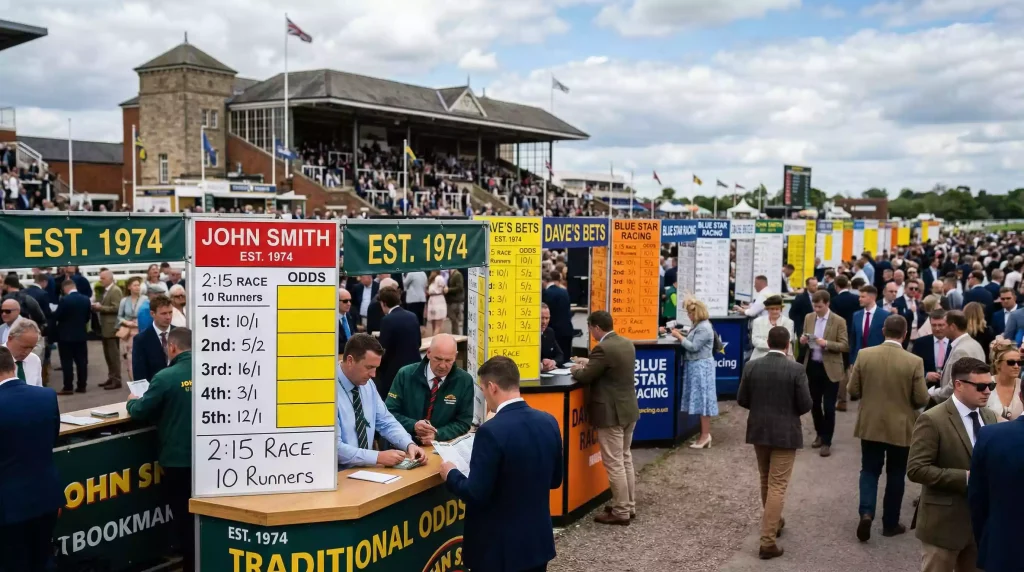
The odds on a Windsor race card are not fixed points — they are living numbers that shift from the moment overnight prices are published to the instant the starting price is recorded at the off. Every movement carries information: stable confidence, going changes, draw revelations after non-runners, the weight of money from punters who think they know something the market has not yet absorbed. Understanding how windsor racecourse odds form and move is a separate skill from picking winners, but it makes the difference between backing a horse at 10/1 and catching it at 6/1 after the smart money has arrived.
This guide follows the lifecycle of a Windsor price from overnight market to SP, explains the role of Tote pools and exchanges, and shows how to read market movers for what they are — the price is talking, and it pays to listen.
Tracking Windsor Betting Odds: From Overnight Price to SP
The odds lifecycle begins the evening before a meeting, when bookmakers publish overnight prices based on their initial tissue — a theoretical set of prices reflecting each horse’s perceived chance. These early prices are often generous by design: bookmakers want to attract overnight bets, and they build in a margin that they expect to tighten as the market matures. At Windsor, overnight prices for Monday evening cards tend to be published on Sunday night, giving punters a roughly twenty-hour window before the first race.
Morning prices adjust as the market absorbs information. If a trainer has spoken positively about a horse in the racing press, if the going has changed overnight, or if a key rival has been declared a non-runner, the prices shift. These movements are visible on the Racing Post and major bookmaker sites, and tracking them between 8 AM and noon on race day gives a useful snapshot of where the money is heading. A horse that shortens from 8/1 to 5/1 overnight is being backed; a horse that drifts from 4/1 to 7/1 is being avoided.
The starting price — SP — is recorded by an independent assessor at the moment the stalls open, based on the prices available from on-course bookmakers. It is the benchmark against which all bets placed at SP are settled. At Windsor, as across all British racing, the SP reflects the final consensus of the on-course market, which can diverge from the exchange price or the best-price-guarantee price offered online. The BHA’s 2026 Racing Report noted that overall betting turnover in British racing fell by 4.3% year on year, with the decline concentrated on lower-tier fixtures — a trend that has implications for the depth of the on-course market at venues like Windsor, where evening cards attract thinner books than Saturday feature meetings.
That turnover decline matters for odds quality. Thinner markets mean wider spreads and greater vulnerability to single large bets moving the price. A £500 wager placed with an on-course bookmaker at Ascot on Champions Day will barely ripple the market; the same bet at a Windsor Monday evening meeting can move the SP by a full point. Awareness of market depth is part of reading the odds intelligently.
Tote Pools and Exchange Odds at Windsor
The Tote operates pool betting at all British racecourses, including Windsor. Pool betting works differently from fixed-odds: your payout is determined not by the price at which you bet, but by the total pool divided among winning ticket holders after the operator’s commission. The advantage is that you are not betting against the bookmaker — you are betting against other punters. The disadvantage is that you do not know your exact return until after the race.
Windsor is an Arena Racing Company venue, and ARC operates sixteen racecourses responsible for approximately 39% of all British fixtures. The combined turnover across ARC venues feeds into the Tote’s national pool, meaning that even a moderately attended Windsor evening card benefits from pooled liquidity across the ARC network. In practice, the Tote dividend at Windsor is often competitive with the SP in smaller fields but can diverge significantly in large handicap fields where the market is less concentrated.
Betting exchanges — principally Betfair — offer a third price layer. Exchange odds are set by the market itself, with punters both backing and laying each horse. The exchange price often leads the bookmaker market, particularly in the final thirty minutes before a race. A horse whose exchange price shortens rapidly while the bookmaker price is slow to adjust represents a potential value discrepancy — though these windows are narrow and close quickly as the market corrects. For Windsor’s evening cards, exchange liquidity is typically lower than for weekend fixtures at premier venues, which means the exchange price can be less reliable as a signal.
What Market Movers Tell You
A market mover — a horse whose price shortens significantly between the morning and the off — is a signal, not a certainty. The signal can mean several things: the connections have backed it (stable money), the going change suits it, a key rival has been withdrawn, or a prominent tipster has selected it and generated a wave of public money. Distinguishing between these causes is the art of market reading.
Stable money tends to arrive early and move the price steadily. If a horse shortens from 10/1 to 6/1 between 9 AM and noon, and the movement is not explained by any public information — no going change, no non-runner, no major tip — the likely cause is connected money. This type of movement carries the most information, because the trainer and their inner circle know more about the horse’s wellbeing and readiness than the public market.
Drifters — horses whose prices lengthen through the day — carry information too, though it is often ambiguous. A horse may drift because the going has moved against it, because the trainer has told connections it is not fully wound up, or simply because money is flowing elsewhere. At Windsor, where pace bias is so dominant, a horse that drifts from 5/1 to 8/1 may be reflecting the market’s reassessment of its running style relative to the expected pace scenario. If two confirmed front-runners are declared in the same race, the market may conclude that neither will lead unchallenged, reducing both horses’ chances.
Monday Night Odds vs. Saturday Odds
The structure of the market varies depending on when Windsor races. Monday evening fixtures draw a different crowd — and a different betting profile — from weekend meetings. The on-course market is thinner on Monday evenings, which means that SPs can be more volatile and less reflective of true probabilities. A favourite that opens at 2/1 in the morning may SP at 6/4 or 5/2 depending on how the on-course books trade in the final minutes, with relatively small sums driving the movement.
For punters, this volatility creates both risk and opportunity. The risk is that SP bets on Monday evenings are settled at prices that may not represent fair value. The opportunity is that early prices — taken in the morning or at best-odds-guaranteed bookmakers — may offer better value than the SP, because the morning market is set against a broader liquidity base that includes online money. Taking a price early on a Windsor Monday evening selection, rather than waiting for the SP, is a pragmatic adjustment to the market’s structural thinness.
Saturday and feature-day meetings at Windsor — the Winter Hill Stakes, the Sprint Series Final, the Berkshire Winter Million — generate deeper markets with more competitive pricing. The SP on these days is a more reliable reflection of the horse’s true chance, because the on-course books have more money flowing through them. The lesson is simple: adjust your approach to the market based on the day. The price is talking — but on Monday evenings, it speaks with a softer voice.
