
Best Windsor Trainers and Jockeys: Strike Rates and Statistics
 Available in US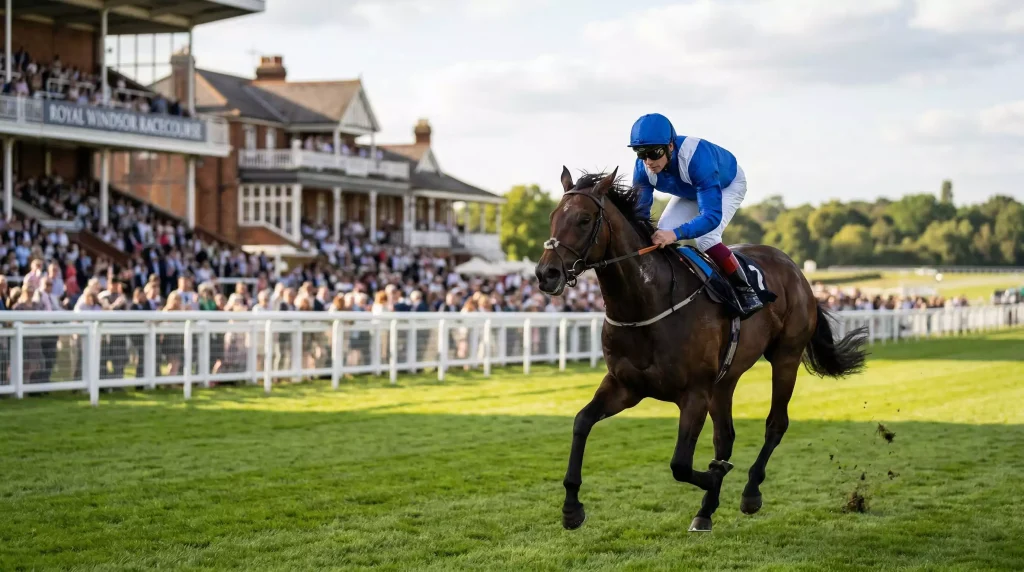
Ask who the best jockeys at Windsor racecourse are and most people will name the rider with the most winners. That answer is incomplete at best and misleading at worst. The numbers behind the names reveal a more nuanced picture: trainers who win often but lose money for level-stakes backers, jockeys who thrive at specific distances but struggle at others, and a handful of genuine course specialists whose records at Windsor bear almost no resemblance to their overall industry statistics. Understanding those distinctions is where the betting edge lies.
Take the trainer table as an example. Richard Hannon leads the Windsor standings with thirty-two winners over five seasons — an impressive headline. But a punter who backed every Hannon runner at level stakes over that period would have finished in the red. Meanwhile, R M Beckett, with twenty-six winners from the same timeframe, shows a Level Stakes Profit of +2.49 — meaning that backing every Beckett runner at starting price would have returned a profit. The gap between volume and value is the central theme of this analysis, and it runs through every jockey and trainer statistic at the course.
What follows covers the top trainers ranked by wins and by profitability, the flat and jump jockeys who have built the strongest course-specific records, the Winter Hill Stakes power rankings that reveal who dominates Windsor’s biggest race, how to interpret jockey and trainer form in practical terms, and the names to watch as the 2026 season takes shape.
Top Windsor Trainers: Total Wins Versus LSP Profitability
Level Stakes Profit — LSP — is the metric that separates genuine course specialists from trainers who simply run a lot of horses. The concept is straightforward: if you had placed a one-unit bet on every runner from a given trainer at the starting price, would you have made money or lost it? A positive LSP means the trainer’s runners have, on aggregate, been underestimated by the market. A negative LSP means the market has correctly assessed — or overestimated — the trainer’s chances, and backers have paid the price.
At Windsor, the OLBG data over five seasons tells a clear story. Richard Hannon (Junior) sits at the top of the wins table with thirty-two victories, a figure that reflects the sheer volume of runners he sends to the course. Hannon trains a large string in Wiltshire, and Windsor’s Monday-night cards are a natural target for his lower-class handicappers and novice runners. But quantity does not translate into profitability. Hannon’s LSP is negative, which means that the market prices his horses accurately or too short — and over a large sample, backers lose.
R M Beckett, based in Kimpton, presents the opposite case. Twenty-six winners from fewer runners, and an LSP of +2.49 — the highest among trainers with a meaningful sample at Windsor. Beckett’s runners tend to be less fashionable than Hannon’s, which means their starting prices are longer, and when they win, the returns are proportionally greater. The profile is typical of a genuine course specialist: a trainer who knows the track intimately, targets specific types of races, and sends horses that are ready to perform rather than using the course for education.
Between Hannon and Beckett, the trainer table contains a spread of familiar names. Andrew Balding, Clive Cox, and Roger Varian all feature prominently by win count, reflecting the concentration of major flat yards within travelling distance of Windsor. Their LSP figures tend to cluster around zero — neither profitable nor disastrous — which suggests the market prices their runners fairly. For punters, these trainers are neither an edge nor a trap; they are priced correctly, and the value must come from other factors like draw, pace, or jockey booking.
Further down the table, smaller operations occasionally produce LSP spikes that deserve attention. A trainer with eight or ten winners and a strongly positive LSP may not have the volume to dominate the standings, but their per-runner profitability suggests a genuine understanding of which races to target at Windsor. These yards tend to be local — based in Berkshire, Hampshire, or Wiltshire — and their horses have often run at Windsor before. The combination of course familiarity, selective targeting, and longer starting prices is what drives a positive LSP, and it is exactly the kind of pattern that rewards punters who look beyond the obvious names.
The practical lesson is to resist the instinct to back the biggest name. A Hannon runner at 3/1 is not necessarily better value than a Beckett runner at 8/1, even if Hannon has won more races at the course. The market already knows that Hannon sends a lot of horses to Windsor; it prices them accordingly. What the market sometimes underestimates is the specialist trainer whose volume is lower but whose strike rate per runner is higher. Beckett is the clearest current example, but the principle applies to any trainer whose LSP deviates significantly from zero in either direction.
One caveat: LSP figures are backward-looking and can shift from season to season. A trainer who showed +3.0 over three years might drop to –1.0 if they have a poor twelve months. The most reliable approach is to combine LSP with a qualitative assessment of why a trainer performs well at Windsor — familiarity with the track, proximity of the yard, types of horses in training — and to update the data annually. OLBG refreshes its Windsor trainer statistics regularly, and checking the current numbers before the season starts is a worthwhile five-minute exercise.
Course Specialist Jockeys: Flat and Jump
Jockey statistics at Windsor split naturally into two categories: flat riders who accumulate course form across the thirteen Monday-night cards and the summer feature days, and jump jockeys who are only now beginning to build records at a course that has hosted National Hunt racing for barely two seasons.
On the flat, the historical standout is Frankie Dettori. His overall record at Windsor is strong, but it is the Winter Hill Stakes that defines his association with the course: five victories in the Group 3, more than any other jockey. That record is now closed — Dettori has stepped back from British racing — but it remains the benchmark against which current riders are measured. The At The Races stats guide records that no other jockey has won the Winter Hill more than three times, which underlines how dominant Dettori was in that particular race.
Among active flat jockeys, the names to watch are those who ride regularly for the trainers with the strongest Windsor records. Riders retained by Hannon, Balding, and Cox tend to appear on the Monday-night cards week after week, and that repetition builds a practical familiarity with the track’s quirks — where to position through the elbow, how to judge the pace on the long straight, when to commit on soft ground — that visiting jockeys cannot replicate from a single ride. Strike rate by course is a more useful metric than raw winners for identifying these riders: a jockey who wins 15 per cent of rides at Windsor versus 10 per cent nationally is demonstrably more effective at this specific track.
The jump side is a shorter story, but two names stand out from the opening seasons. Harry Cobden partnered Ma Shantou to win the first jump race at Windsor in December 2026 — a symbolic result for a jockey who is already established as one of the leading National Hunt riders in the south. Harry Skelton rode Protektorat to that extraordinary twenty-three-length victory in the Fitzdares Fleur de Lys Chase at the inaugural Berkshire Winter Million in January 2026. Both jockeys have the kind of course experience — albeit brief — that gives them an edge over rivals who have never ridden at Windsor over obstacles.
As the jump programme matures, the jockey statistics will deepen. For now, the practical advice is simple: favour riders who have already ridden at Windsor over jumps, because the figure-of-eight layout with its directional changes and long home straight is genuinely unusual, and first-time experience of it under racing conditions is a disadvantage.
Across both codes, the thread that connects the best jockeys at Windsor is repetition. This is not a track that rewards occasional brilliance. It rewards riders who come back week after week, learn the geometry, and apply that knowledge under pressure. The numbers behind the names point consistently in that direction.
Winter Hill Stakes: The Trainer–Jockey Power Rankings
The Winter Hill Stakes deserves its own statistical treatment because its trainer and jockey records are so concentrated. In a race with roughly fifty renewals, two trainers — Sir Michael Stoute and Saeed bin Suroor — account for seventeen victories between them. That level of dominance is rare in any pattern race, and it shapes the way punters should approach the Winter Hill in any given year.
Stoute’s nine wins span multiple decades and reflect a consistent strategy: he identifies middle-distance horses with the class to handle Group 3 company but without the profile to run in the major autumn events, and he targets the Winter Hill as a career-highlight race. Several of his winners have gone on to better things after Windsor, using the Group 3 as a confidence-builder. Suroor’s eight victories follow a different pattern — Godolphin runners are typically higher-profile and better-fancied in the market, which means their returns at starting price are lower even when they win.
The draw adds a layer of predictability that reinforces the trainer data. Stall one has produced five winners in the last thirteen editions, and stall two another two. When a Stoute or Suroor runner draws stall one or two, the historical case is overwhelming: class from a dominant trainer, plus the positional advantage of the inside rail through the right-hand bends, plus the long home straight that protects front-runners. It is rare in racing to find so many factors pointing in the same direction.
But the competitive landscape is shifting. “Trends are moving in the wrong direction for both Flat and Jump horses, so the sport has recognised the need to develop a strategy to support growth in the size and quality of the horse population in Britain,” Richard Wayman, Director of Racing at the BHA, noted in the 2026 Racing Report. The declining horse population means fewer runners per race and potentially weaker fields in the Group 3 bracket. For the Winter Hill, that could mean smaller fields than usual — six or seven runners instead of eight or nine — which amplifies the draw advantage further. If stall one is decisive in a field of nine, it is even more decisive in a field of six.
For bettors, the Winter Hill power rankings offer one of the most bankable angles in the entire Windsor calendar. Check the trainer (Stoute or Godolphin?), check the draw (stall one or two?), check the going (good to firm?), and check the pace (is this horse a natural front-runner?). When three or four of those boxes are ticked, the Winter Hill is one of the most data-friendly betting races in British flat racing.
How to Read Jockey and Trainer Form at Windsor
Jockey and trainer form at Windsor is not the same as jockey and trainer form nationally, and treating the two interchangeably is a common mistake. A jockey riding at 12 per cent nationally might ride at 18 per cent at Windsor, and that gap — six percentage points — translates into real value if the market has not adjusted for it. The key to reading course-specific form is knowing where to find the data and how to interpret it.
Most racing databases — the Racing Post, Timeform, OLBG — allow filtering by course. The statistics you need are strike rate (winners as a percentage of rides), place rate (placed finishes as a percentage of rides), and LSP (profit or loss to level stakes at starting price). Strike rate tells you how often a jockey or trainer wins at the track; LSP tells you whether the market has priced that success accurately. A high strike rate with a negative LSP means the market already knows this person wins often and prices them accordingly, leaving no value for backers. A moderate strike rate with a positive LSP means the market is underestimating them — and that is where the edge lives.
Financial context matters too. The Professional Jockeys Association publishes current riding fees: £173.54 per ride for flat jockeys in 2026/26 and £235.90 for jump jockeys. On top of that, flat jockeys receive approximately 7 per cent of prize money for a win, while jump jockeys receive roughly 9 per cent. A winning ride in a Class 4 flat handicap worth £10,000 in prize money earns the jockey around £700 on top of their riding fee. In a Class 2 sprint worth £30,000, the jockey’s share rises to over £2,000. These numbers explain why the best jockeys are selective about where they ride: a high-value race at Windsor is worth significantly more than a low-value race at a less accessible track.
For trainers, the equivalent calculation involves travel costs, staffing, and the likelihood of picking up prize money. A trainer based in Lambourn — thirty minutes from Windsor by road — has a much lower cost of entry than a trainer based in Newmarket, two hours away. That proximity bias explains why southern trainers dominate the Windsor statistics: they run more horses at the track because the economics are more favourable, and the resulting course experience compounds over time.
The practical approach to reading form at Windsor is to build a shortlist at the start of each season. Identify the five or six trainers with the highest LSP from the previous year, note the three or four jockeys with the best course strike rates, and flag any combination of trainer and jockey that appears repeatedly. When that combination shows up on a Monday-night card — particularly with a horse that has its own course form — the statistical alignment is strong enough to justify a bet, even in a competitive handicap.
Ones to Watch in 2026
Projecting the 2026 season at Windsor requires a blend of recent form, stable reports, and inference from the 2026 results. On the flat, the trainers to track are the ones who showed the strongest LSP figures in 2026 — Beckett remains near the top of that list, but keep an eye on any yard that had a notably profitable autumn or early-spring run at the course. The Monday-night cards reward consistency, and a trainer who wins twice in April is likely to return with similar types throughout the summer.
Among flat jockeys, the stable-jockey bookings for the leading Windsor trainers will tell you most of what you need to know. When Hannon, Balding, or Cox book a senior jockey for a Monday-night card, it signals confidence. When they use a claiming apprentice — a younger rider who carries a weight allowance — the implication is that the horse needs the weight reduction more than it needs an experienced hand on the reins. Both scenarios are informative; neither should be ignored.
The jump programme is where the most interesting shifts are likely to occur in 2026. Dan Skelton, who trained Protektorat to that dominant BWM victory, is expected to increase his presence at Windsor as the winter programme expands. Emma Lavelle, whose Ma Shantou won the first jump race at the course, is based locally and has a natural incentive to target Windsor fixtures. Both trainers have expressed enthusiasm for the figure-of-eight jump circuit, and their entries in the autumn and winter meetings will be worth monitoring closely.
One broader factor to consider is the declining horse population nationally. With fewer horses in training — 21,728 in 2026, down 2.3 per cent — fields at mid-tier courses like Windsor could shrink, particularly in the Class 4 and Class 5 races that fill the Monday-night cards. Smaller fields compress the odds and reduce the scope for big-priced winners, but they also make form analysis more reliable because there are fewer unknowns in the race. The numbers behind the names will matter more, not less, in a contracting market — and the trainers and jockeys who know Windsor best will be the ones who capture a disproportionate share of a smaller prize pool.
Many of these top-performing professionals specifically target Windsor’s key races like the Winter Hill Stakes to maximize their prize money.
Discover comprehensive course analysis and expert predictions at the ultimate Windsor horse racing website.
