
Key Races at Windsor: Winter Hill Stakes and Featured Events
 Available in US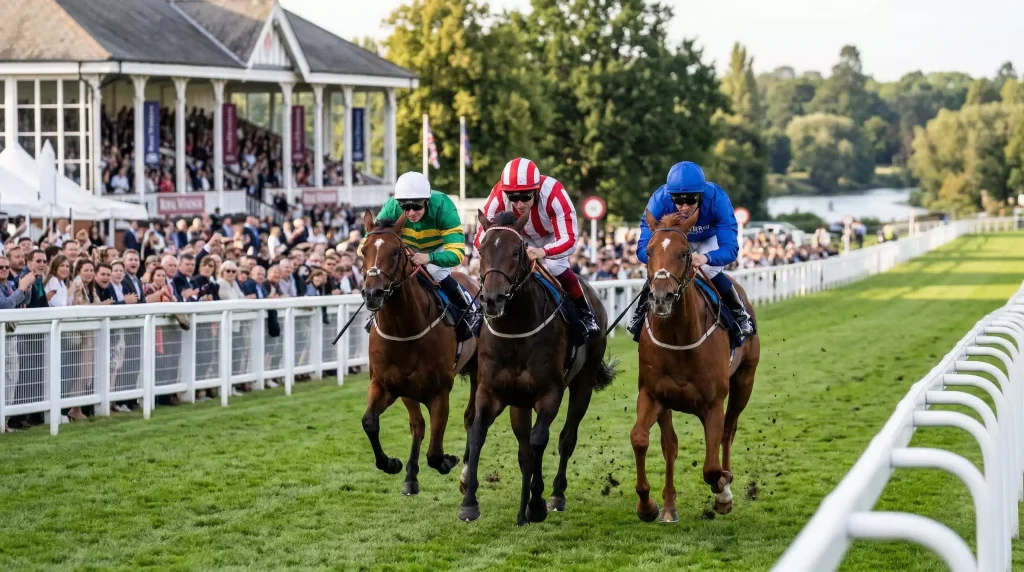
Windsor is not a course that does things by halves, yet its race programme often gets filed under “handy for a Monday evening punt” and nothing more. That undersells the place considerably. The track stages Britain’s southernmost Group 3 — the Winter Hill Stakes, which has attracted champions from Sir Michael Stoute’s yard for decades — and a sprint series whose final carries a purse of £75,000, a figure that dwarfs most Class 2 handicaps anywhere in the country. Windsor racecourse key races stretch from the heights of pattern-race prestige to the scrappy, competitive handicaps that fill the bread-and-butter cards, and the range is wider than most punters realise.
What makes Windsor’s programme unusual is the combination of depth and theatricality. Few racecourses can claim both a Group 3 and a full series of ten qualifying sprints that funnel into a single championship final. Fewer still have successfully reintroduced jump racing after a gap of two decades and built a three-day winter festival around it within twelve months. The result is a calendar where the Group 3 meets the Monday night — where a listed event in June shares billing with a novice stakes in April, and where the January jump cards carry prize money that would have seemed fanciful five years ago.
This article profiles the races that define Windsor’s identity: the Winter Hill Stakes, the Fitzdares Sprint Series, the Royal Windsor Stakes and its listed companions, the new jump programme, and the class-level racing that fills more fixtures than any headline event. Each profile covers history, format, prize money, key statistics, and what to watch for in 2026.
Winter Hill Stakes History: Group 3 Winners Since 1995
The Winter Hill Stakes has been part of the Windsor fixture list since 1975, which makes it older than most of the Monday-night audience and considerably older than the course’s jump-racing programme. For its first two decades the race was a conditions event of middling prestige, the kind of race that attracted decent middle-distance horses who were not quite good enough for the top Group events at Ascot or Newmarket. That changed in 1995 when the British Horseracing Authority upgraded it to Group 3 status, and overnight the Winter Hill became the centrepiece of the Windsor flat calendar.
The race is run over a mile and two furlongs in late August, typically on a Saturday afternoon card that draws a larger crowd than the regular evening meetings. The 2026 prize fund stood at £70,000 — an increase of £10,000 compared with 2023 — with the winner collecting £39,697. That purse is modest by Group 3 standards nationally, but it is comfortably the largest single prize available at Windsor on any given race day, and it attracts runners from the top Newmarket and Lambourn yards who might otherwise bypass the course entirely.
The roll call of trainers who have dominated the Winter Hill reads like a shortlist of British flat racing’s establishment. Sir Michael Stoute holds the record with nine victories — a remarkable tally for a single race at a single course. Saeed bin Suroor, the long-standing Godolphin handler, has eight. Between them, two trainers account for more than a third of all renewals since the race’s inception. On the jockey side, Frankie Dettori rode five Winter Hill winners, a record that seems likely to stand for some time now that he has stepped back from British racing. The At The Races stats guide confirms that no other jockey has managed more than three.
The course record belongs to Al Kazeem, who clocked 2:01.62 over the mile-and-two-furlong trip in 2014. Al Kazeem was no ordinary Winter Hill runner — he had already won the Eclipse and the Prince of Wales’s Stakes — and his time remains the benchmark by which subsequent renewals are judged. The race’s Wikipedia entry records that the mark has stood for over a decade. It is worth noting that the record was set on good to firm ground, which underlines how the combination of fast going and Windsor’s long home straight can produce genuinely quick times at middle distances.
The draw is a factor in the Winter Hill that punters consistently underestimate. Over the last thirteen renewals, stall one has produced five winners. Stall two accounts for another two. That means the two lowest stall positions have supplied more than half of all Winter Hill victors in over a decade — a bias that is statistically significant even in a small-field race where the sample is inherently limited. The most likely explanation is the course geometry: the mile-and-two-furlong trip involves several right-hand bends, and low-drawn horses hold the rail advantage through each of them. In a field of seven or eight, where there is little traffic to impede, the inside berth is worth the equivalent of a length or more before the home straight even begins.
For punters assessing the 2026 Winter Hill, the checklist is short. Look for a Stoute or Godolphin runner drawn low, with form on good to firm ground, who races prominently. That profile has won this race more often than any other. The Group 3 tag ensures that the field quality is high enough to attract pattern-class performers, but not so high that the race becomes a satellite of the major autumn festivals. The Winter Hill occupies a sweet spot in the calendar: serious enough to matter, accessible enough to reward homework.
One detail that often escapes the previews is the timing. Late August means the ground is usually at its quickest, the flat season is entering its final act before the autumn, and trainers are making decisions about which horses to campaign through to Champions Day in October. The Winter Hill often serves as a trial — not officially, but in practice — for races like the Champion Stakes or the International Stakes. Watching which runners use Windsor as a stepping stone, and which treat it as a peak target, is one of the quieter edges available to the attentive punter.
Fitzdares Sprint Series: 10 Qualifiers and a £75,000 Final
If the Winter Hill Stakes is Windsor’s prestige event, the Fitzdares Sprint Series is its populist counterpart — a season-long narrative arc built around speed, qualification, and a climactic final that puts £75,000 on the line. The format is unusual for British racing, where most series are either informal (a loose collection of races with shared conditions) or confined to a single day. Windsor’s sprint series is structured, deliberate, and spread across the entire flat season.
The series comprises ten qualifying races staged between April and July, covering distances of five and six furlongs. The qualifiers range from Class 2 events with prize funds around £30,000 down to Class 4 handicaps worth approximately £10,800. That breadth of class is intentional: it means that a horse who could never compete in a conditions stake can earn its way into the final through a lower-tier qualifier, and the final itself features a mixed-ability field that produces unpredictable results and generous each-way prices.
Qualification works on a points-based system. Runners accumulate points based on their finishing positions in each qualifying race, and the top-ranked horses at the end of the series earn entry to the August final. The system rewards consistency over a single flash of brilliance — a horse that finishes second in three qualifiers may rank higher than one that won a single qualifier and then disappeared. For trainers, the series creates a reason to return to Windsor repeatedly rather than treating the course as an occasional stop on the circuit.
The final itself is a Class 2 handicap run over six furlongs, typically on the same August card as the Winter Hill Stakes. That pairing is deliberate: the Group 3 provides the prestige, and the sprint final provides the spectacle. A £75,000 purse for a handicap sprint is substantial enough to attract serious entries, and the qualification route means that every runner in the field has proved its form at the course. That course experience is a genuine edge — the figure-of-eight layout, the near-straight six-furlong trip, and the long run to the line all favour horses who have navigated them before.
From a betting perspective, the sprint series rewards those who follow the qualifiers throughout the season. By the time the final arrives, an engaged punter has watched most of the field run at Windsor multiple times. That accumulated visual evidence — how a horse handled the straight, whether it coped with evening ground conditions, whether it quickened through the final furlong or flattened — is worth more than any speed figure. The series is, in effect, Windsor’s own form laboratory, and the final is the exam.
Royal Windsor Stakes and Other Listed Events
Below the Winter Hill in the hierarchy sit Windsor’s Listed races, led by the Royal Windsor Stakes. Listed status is the first rung on the black-type ladder — a step above handicap class but below Group 3 — and for owners and breeders the distinction matters enormously. A Listed win appears in a horse’s pedigree page, and that line of text can add thousands of pounds to the value of a mare’s future offspring. Windsor’s Listed programme attracts runners whose connections are chasing that page entry as much as the prize money itself.
The Royal Windsor Stakes is the course’s flagship Listed event, run over a mile on a summer evening card. It draws a field of progressive three-year-olds and exposed older horses, and its position in the calendar — June, typically — means it catches runners on the way up who might go on to better things later in the season. The Leisure Stakes, another Listed race, provides a similar opportunity over a shorter trip. Together, they give Windsor two black-type events alongside the Group 3, a tally that puts the course ahead of several larger venues in terms of pattern-level opportunities.
The quality of Windsor’s listed programme has improved in tandem with prize money across British racing. “The £194.7 million in prize money is an encouraging level of investment and an incentive for participants to enter horses at British racecourses,” Kevin Walsh, Racing Director at the Racecourse Association, noted when the 2026 totals were confirmed. That rising tide lifts listed races as much as any other category: higher purses attract better horses, which raises the standard, which in turn makes the race more valuable as a form reference for subsequent entries elsewhere.
For punters, listed races at Windsor share the same tactical considerations as any other flat race on the course. The draw biases documented for middle distances apply to the Royal Windsor Stakes just as they apply to a Monday-night handicap. The difference is field size — listed races typically attract eight to twelve runners, which reduces the draw’s impact relative to a twenty-runner cavalry charge. Pace remains the dominant variable. A front-running listed-race type drawn in a low stall on summer ground is the profile that Windsor’s layout rewards most consistently.
Compared with other ARC-operated racecourses, Windsor’s programme punches above its weight. Several tracks in the ARC portfolio stage more fixtures but fewer pattern-level races. Windsor’s combination of one Group 3, two Listed events, and the structured sprint series gives it a fixture card with genuine peaks, not just volume. That quality matters for results analysis: when a horse wins a listed race at Windsor, the form has substance behind it.
The Jump Racing Card: A New Chapter
National Hunt racing returned to Windsor on 15 December 2026 — the first jump fixture at the course in approximately nineteen years. Regular jump meetings had ceased in 1998, though Windsor briefly hosted some of Ascot’s National Hunt fixtures during its redevelopment in 2004 and 2005. The comeback was not a soft launch. Ma Shantou, ridden by Harry Cobden and trained by Emma Lavelle, won the first race — a novice hurdle — and the symbolism was not lost on anyone in attendance: a Berkshire-trained horse winning a Berkshire jump race at a course that many assumed would never see another obstacle erected on its turf.
The reintroduction of jump racing at Windsor was driven by Arena Racing Company’s investment in drainage, new turf sections, and upgraded obstacles across previously unused portions of the 165-acre site. The initial season in 2026/25 used a left-hand oval configuration, a departure from the figure-of-eight layout that the flat course is known for. Feedback from trainers and jockeys after the first three meetings led to a significant change: from November 2026, jump racing at Windsor reverted to the traditional figure-of-eight circuit, with a safety factor of 16 applied to all jump races.
Within months of the first jump fixture, Windsor and Ascot announced the Berkshire Winter Million — a three-day jump festival held in January 2026 with a combined prize fund of £1.25 million. The festival’s headline race, the Fitzdares Fleur de Lys Chase, had already made an impression in its inaugural edition in January 2026, when Protektorat won by twenty-three lengths under Harry Skelton for trainer Dan Skelton. That margin was so decisive that it immediately established the BWM as a fixture worth targeting, not just attending.
The jump programme now sits alongside the flat calendar as a genuine second code at Windsor, running from November through to March. The races are primarily novice hurdles, handicap chases, and conditions events in the Class 3 to Class 5 range, though the BWM elevates the January card to a level comparable with the more established winter festivals at Cheltenham and Newbury. For a course that was flat-only for a quarter of a century, the speed of the transition has been remarkable.
From a results perspective, the jump programme is too young to have generated the kind of long-term statistical patterns that characterise the flat data. There is no ten-year draw bias dataset for Windsor hurdles. What can be said, based on the first season, is that the long home straight — the same five furlongs that defines the flat racing — also favours prominent jump racers, and that the figure-of-eight configuration places a premium on horses who handle changes of direction under jumping conditions. As more seasons of data accumulate, the jump results at Windsor are likely to develop their own set of biases and tendencies worth tracking.
Class 3–5: The Bread and Butter of the Windsor Calendar
Strip away the Group 3, the listed races, and the sprint series final, and what remains is the engine room of the Windsor calendar: Class 3, 4, and 5 handicaps, novice stakes, maiden races, and the occasional conditions event that fills the standard evening and afternoon cards. These races do not generate press releases or sponsor activations, but they account for the vast majority of Windsor’s twenty-six annual fixtures and the vast majority of results that punters actually bet on.
The class system in British racing assigns every race a number from 1 (the highest) to 7 (the lowest). Windsor’s regular programme operates predominantly in the Class 3 to Class 5 range, which covers horses rated roughly 0-85 on the official handicap scale. Class 3 handicaps attract useful, competitive types — the kind of horse that wins two or three races a season and provides its owner with a genuine return. Class 5 maidens feature first-time runners and exposed underperformers still searching for a breakthrough. The quality gap between those extremes is substantial, and reading the class of a race correctly is a prerequisite for any meaningful results analysis.
Handicaps dominate the programme. A typical Monday-night card at Windsor features five or six handicaps — sprint and mile trips — and one or two non-handicap events. The handicap format means that the British Horseracing Authority’s official handicapper assigns each horse a weight designed to equalise the field. In theory, every runner should finish together; in practice, the handicapper’s assessment is imperfect, and horses whose ability is improving faster than their mark will find these races generous. Spotting those improvers is the primary skill required for Windsor’s bread-and-butter cards.
Novice stakes and maiden races add variety. Novice stakes are restricted to horses that have won no more than once, which means the fields contain a mix of unexposed potential and proven limited ability. Maiden races — restricted to horses that have never won — are the most unpredictable events on any card, because the field may include a well-bred newcomer from a major yard alongside a ten-time loser from a smaller operation. The form book is thinner, the data is noisier, and the prices tend to be more generous as a result.
What ties all of these races together is the course itself. The draw biases, pace patterns, and going effects that govern the Group 3 and the listed races apply just as firmly to a Class 5 maiden on a Tuesday afternoon. A front-runner drawn low in a sixteen-runner handicap over a mile on good ground benefits from exactly the same geometry as a Group 3 contender in the Winter Hill. The difference is the quality of the animals, not the physics of the track. That consistency is what makes Windsor a rewarding course to specialise in: learn the biases once, and they pay out across every level of the programme, from January to September, from the bread and butter to the best in class.
